

All my investigations are free to read, thanks to the enormous generosity of my readers. Independent journalism nonetheless requires investment, so if you value this article or any others, please consider sharing, or even becoming a paid subscriber. Your support is always gratefully received, and will never be forgotten. To buy me a coffee or two, please click this link.
On December 4th, a long-running Inquiry into the mysterious July 2018 death of Dawn Sturgess delivered its final report. To the surprise of surely no one, it concluded Sturgess was contaminated with Novichok as a result of the attempted assassination of GRU defector Sergei Skripal in Salisbury by Russian intelligence operatives, directed by Vladimir Putin, four months earlier. While the mainstream media unquestioningly accepted the findings as unchallengeable gospel, evidence heard and produced throughout the Inquiry raised considerably more questions than it provided answers.
Sturgess’ death, many miles away from Salisbury, was a puzzling coda to the already enigmatic poisonings of Sergei Skripal and his daughter Yulia in March 2018. She is the only person in history known to have died from coming into contact with Novichok, despite the substance being the most lethal nerve agent known to man, and Russian intelligence repeatedly using it to strike targets - purportedly. Her boyfriend Charlie Rowley allegedly gifted her a bottle of Novichok disguised as perfume, which he found - when and where, he seemingly doesn’t know.
Despite apparently spraying the substance on his hands, then wiping it on his jeans, Rowley didn’t die. He was hospitalised unconscious on June 30th 2018, hours after Sturgess collapsed, having unwittingly contaminated herself with Novichok. Or so British authorities would have us believe. Rowley awoke on July 10th, two days after Sturgess’ death. Inexplicably, he was one of many absolutely key witnesses the Inquiry neglected to call to testify. Then again, the process was a flagrant whitewash farce from start to finish.
Under English law, a coroner’s inquest should typically be completed within six to nine months of an individual’s passing. However, as independent journalist John Helmer has extensively documented, British authorities were suspiciously resistant to convening one for Sturgess. It was only after intense legal battles between Sturgess’ family and the government that an Inquiry was instituted. Unlike inquests, which have sweeping legal powers, inquiries are little more than flaccid public relations exercises. Those interviewed and evidence considered was strictly limited, by state decree.
This fudge conveniently prevented British intelligence agencies from scrutiny - an astonishing shortfall, given much of the Inquiry focused on the supposed link between the poisonings of the Skripals and Sturgess’ death. Inquiry chief Anthony Hughes, a former Supreme Court judge, concluded the Skripals’ alleged GRU assassins, Alexander Petrov and Ruslan Boshirov, “brought with them to Salisbury” Novichok secreted in a perfume bottle. He added, “it was probably [emphasis added] this bottle that they used to apply poison to the door handle of Sergei Skripal’s house”.
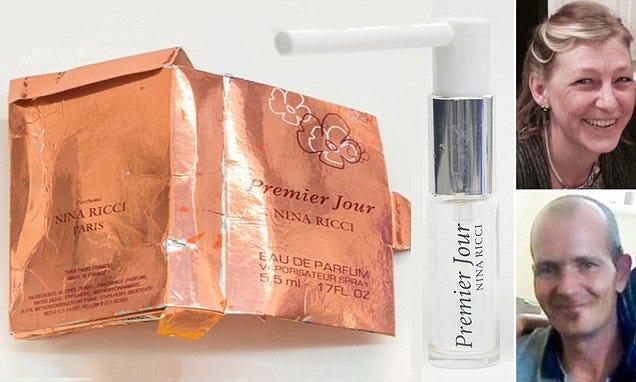
“There is a clear causative link between the use and discarding of the Novichok by Petrov and Boshirov, and the death of Dawn Sturgess,” Hughes ruled. Squaring this circle required stultifying mental gymnastics. Multiple witnesses - some anonymous - suggested the two would-be GRU assassins used a portable heat sealer to conceal the Novichok in the perfume box, after applying the deadly poison to Skripal’s doorknob. The pair then allegedly dumped it in parts unknown for Rowley to find, at an indeterminate place and date.
The Inquiry expended enormous time and energy attempting to validate this dubious narrative, to the extent of consulting an expert on heat sealers at some length. Despite this monumental effort though, Keith Asman, a senior counter-terror officer who participated in the probe of the Skripals’ poisoning, acknowledged under questioning during the Inquiry there was “no forensic evidence whatsoever” to support the assessment a portable heat sealer was used by the alleged GRU assassins. But the Inquiry’s glaring evidentiary issues didn’t end there.
‘Under Surveillance’
Independent journalist Tim Norman has documented in exhaustive detail the myriad contradictions, discrepancies and confounding dualities thrown up over the course of the Inquiry. For example, it was revealed Yulia Skripal, contrary to all prior mainstream reporting, awoke in hospital just four days after her poisoning. Moreover, via blinking, she communicated to an on-duty intensive care doctor she and her father had been “sprayed” with an uncertain substance while they lunched together on March 4th 2018. Police had initially made the exact same judgment.
Nonetheless, the Inquiry attributed no credibility to Yulia’s potentially bombshell, hitherto unrevealed hospital testimony, on the basis she was sedated at the time. By contrast, the Inquiry unquestioningly accepted Charlie Rowley gifted the bottle of Novichok disguised as perfume and discarded by the Skripals’ failed assassins to Sturgess, leading to her death. This is despite Rowley providing wildly discrepant and implausible accounts of when and where he supposedly found the bottle over time, and avowedly poor memory, due to drug addiction and alcoholism.
Yet, perhaps the most marked paradox to emerge over proceedings was Sergei Skripal’s apparently heightened concern, and simultaneous lack of anxiety, about his personal safety. A statement he purportedly wrote in October 2024 - albeit unsigned and undated, rendering it inadmissible under British law - asserts he believed there was a significant risk “Putin would ‘get me’”. Oddly though, Skripal refused to undertake any measures to conceal his identity or location while living in Britain.
His handlers reportedly offered him “protection, including changing my name,” but Skripal “wanted to lead as normal a life as possible, including maintaining my personal and family relationships,” and “felt quite safe” as he’d “received a Presidential pardon from the Russian state.” Besides, his MI6-purchased Salisbury home was situated in “a quiet street built for police officers,” and “several neighbours” of his “were ex-police” - “residents knew and kept an eye out for each other.”
Such was Skripal’s sense of sanctuary, he allegedly didn’t even have “a house security alarm or sensor activated security lights,” let alone CCTV attached to his home, despite this being “recommended”. Skripal reportedly didn’t want to make his house “conspicuous or live under surveillance,” although domestic CCTV cameras are extremely common in Britain. This supposedly self-professed lax attitude to security is at stark odds with the accounts of his friend Roy Cassidy, both in the wake of the Salisbury incident and during the Inquiry itself.
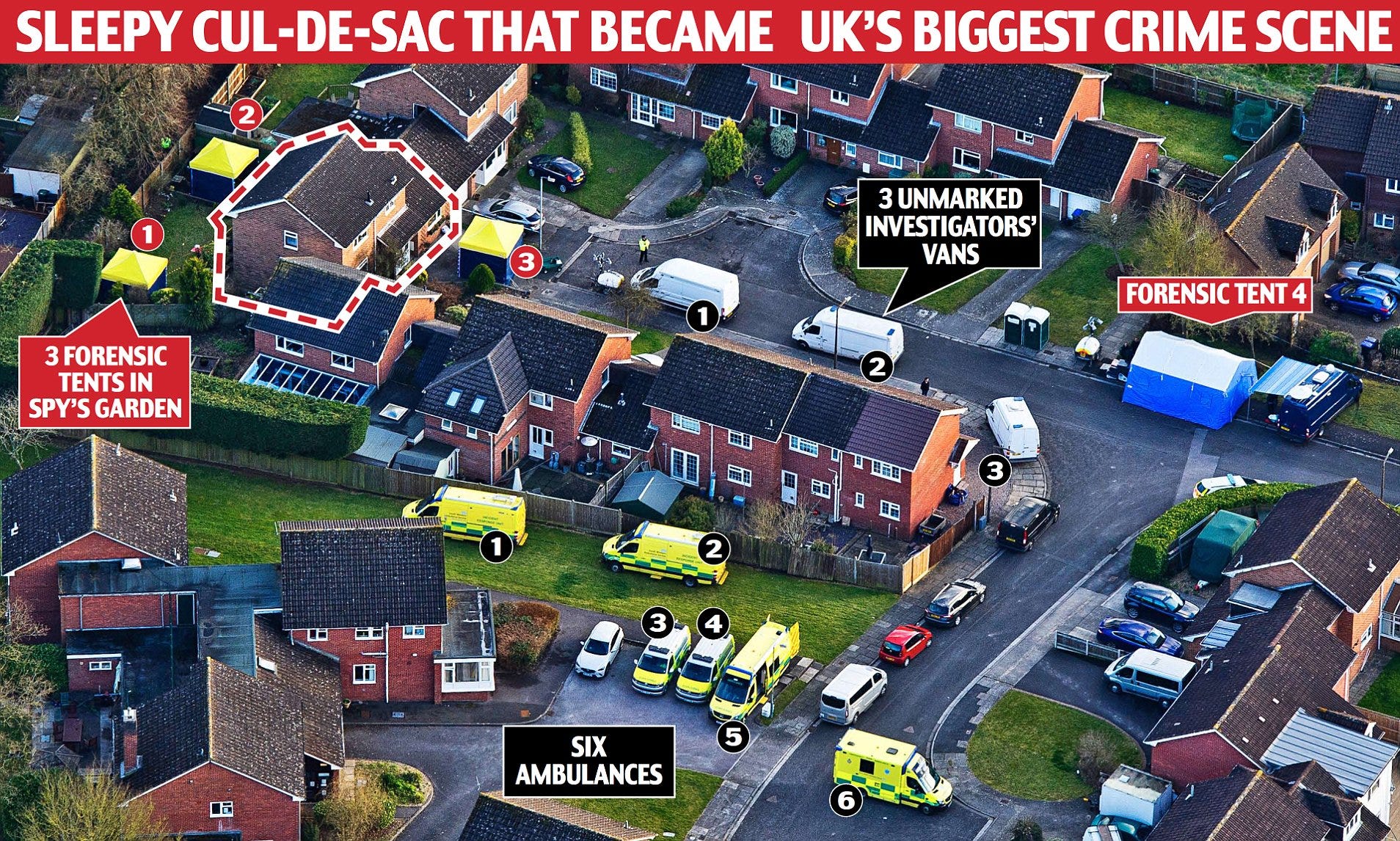
Repeatedly, Cassidy has described Sergei as “watchful and suspicious,” and publicly expressed intense doubt over the proposition Novichok was applied to his front door while he was at home with his daughter, during daytime, without anyone noticing. On top of Sergei’s high-alert ex-police neighbours, his house lay at the end of a cul-de-sac, while his office was sited in a converted garage, providing “a full view of the street” ahead. Sergei spent most of his time at home there. Cassidy has observed:
“These guys are professional assassins. It would have been far too brazen for them to have walked down a dead end cul-de-sac in broad daylight on a Sunday lunchtime…Almost always, Sergei used to open the door to us before we had chance to knock. Whenever we visited, he’d see us approaching.”
According to the Inquiry, Skripal’s GRU assassins conducted a reconnaissance mission on March 3rd in the middle of the day, while Sergei was collecting Yulia from Heathrow airport. A counter-terror officer speculated this was specifically timed for when Sergei was absent from his home. The would-be killers were not only unseen by Skripal’s neighbours during this alleged dummy run, but again evaded detection the next day as they supposedly applied Novichok to his doorknob - right when British police place Sergei in his street-facing office.
‘Entirely Unconnected’
In September 2018, it was reported Skripal and Cassidy, who drove the GRU defector to meet Yulia at Heathrow, told police they were being “tailed” by persons unknown during their journey back to Salisbury. Resultantly, British security services were said to “believe a second team” - in addition to the Boshirov and Petrov two-man “hit squad” - had been involved in the “operation” to assassinate Skripal. Further detail on this “tailing” was provided subsequently by Russopohobic British intelligence mouthpiece Luke Harding:
“On the ride home…at some point it became obvious that a black BMW was shadowing their car. Inside the vehicle was a woman with bleached blonde hair and a man in his forties.”
The Inquiry addressed Cassidy’s certainty an “undercover police car” was “tailing him” and the Skripals from Heathrow. In testimony, he described how “after passing what he believed was a white unmarked police car and slowing down, he then noticed the black BMW keeping pace, either in front or behind him…for a long distance.” However, the Inquiry subsequently “heard” while the two vehicles were correctly flagged by Cassidy and Skripal as undercover cop cars, “they were engaged in ‘entirely unconnected’ police activities at the time.”
This extraordinary co-occurrence is all the more unbelievable, given Harding’s description of individuals in the black BMW “shadowing” Skripal’s car precisely matches a man and woman caught on CCTV walking side-by-side down a Salisbury alley leading to the bench where the unconscious Skripals were found, around 30 minutes prior to their discovery. On March 6th 2018, British police released brief footage of the pair. Reports varied on whether authorities believed them to be the Skripals, or considered them potential suspects in the poisoning attack.
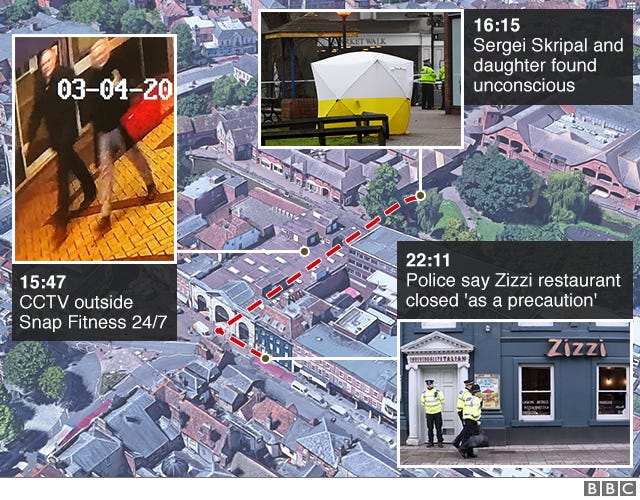
CCTV clips of the Skripals on March 4th 2018 released by the Inquiry indicate the alley twosome bore zero even vague similarity to Sergei and Yulia whatsoever, suggesting they weren’t mistaken for the Skripals by police. Coincidentally though, the unidentified blonde woman was carrying a red bag, just as Yulia was widely reported to have in her possession when found comatose. If officials did view the pair as suspicious, then publishing the images - particularly at such an early stage - was a highly unusual move.
British authorities are typically reticent to release CCTV footage of suspects in unsolved crimes. Such disclosure by definition alerts guilty parties they are on law enforcement’s radar, providing ample impetus to destroy incriminating evidence, or make a break for it. The unidentified pair’s presence in intimate proximity with the poisoned Skripals has been completely forgotten today, and was not probed by the Inquiry. Who they were, and the reasons for their apparent elimination from inquiries if considered suspects, has never been clarified.
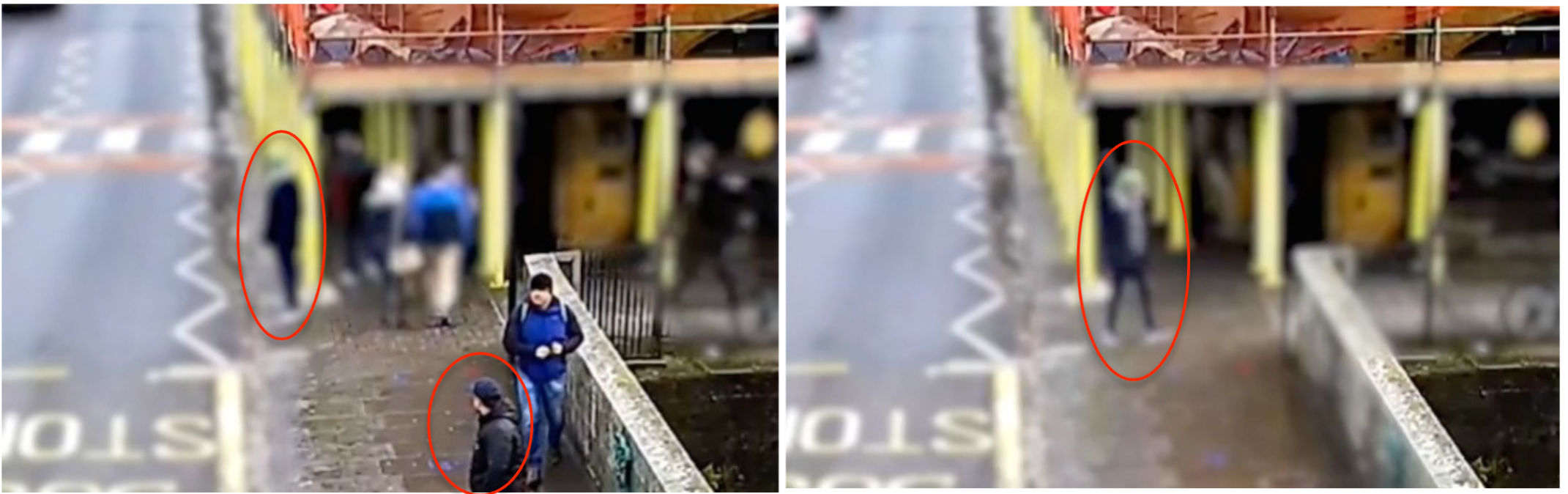
Perhaps there was a “second team” of spies “shadowing” Cassidy and Skripal. As this journalist has previously revealed, there are sinister insinuations Anglo-American intelligence was well-aware of the arrival of Boshirov and Petrov in Britain, and sought to exploit their presence for malign ends. It may be significant that of the 11,000 hours of CCTV footage in Salisbury supposedly seized by police, little has been released. Although, certain frames strongly suggest Skripal’s alleged assassins were under intensive surveillance as they travelled throughout the city.
Surely, if we have learned nothing else from the uk government and its fluffers in the MSM, any stick will do to beat a dog.
Vladimir Putin could be shown to cure AIDS, COVID, and most childhood cancers with his touch, and the Graun would bitch that
1. It doesn't work.
2. It's racist.
3. Putin stole his superpowers.
4. Putin weaponized spiritual healing ZOMG!
Excellent summary, Kit; good work and thanks for it. Anyone who wants the full story on this pathetically flimsy (though, not surprisingly, passively and unquestioningly accepted by the public) piece of the British government's effort to demonize Putin and Russia, should can read John Helmer's 2 volumes "Skripal in Prison" and "Long Live Novichok!". (Helmer also has other books detailing relared pieces of the UK-led EU crowd's coordinated false flag & propaganda campaign designed to whip up enthusiasm among Western publics for waging war against the Eternal Boogeyman Russia.)