

All my investigations are free to read, thanks to the enormous generosity of my readers. Independent journalism nonetheless requires investment, so if you value this article or any others, please consider sharing, or even becoming a paid subscriber. Your support is always gratefully received, and will never be forgotten. To buy me a coffee or two, please click this link.
Since January 13th, government forces have torn across North East Syria. It marks a brutal end to an autonomous region - typically referred to as Rojava - effectively governed by the US-backed, Kurdish-dominated Syrian Democratic Forces for over a decade. While a Washington-brokered ceasefire agreement provides for the SDF’s integration into Damascus’ Western-appointed government, the de facto HTS-controlled military shows every sign of seeking to permanently erase and neutralise all traces of Rojava.
Civilians and SDF fighters have been slaughtered since the region’s takeover. Ahmed al-Sharaa’s thugs have been assisted in their massacres by the freed inmates of local detention centres, among them a profusion of ‘former’ ISIS butchers. These facilities were created in 2019 to accommodate the population of territory once claimed by Islamic State, and today house tens of thousands of people. Markedly, government forces specifically targeted the prisons when their assault on Rojava commenced, strongly suggesting igniting mass jailbreaks locally was a deliberate objective.
Rojava’s ISIS refugee camps posed a complex and seemingly irresolvable problem for the autonomous territory. Inhabitants could only be repatriated with the consent of their home country’s government, which in many cases refused. The Al-Hol camp proved particularly problematic. Housing exclusively women and children, detainees were overwhelmingly the wives and sons and daughters of Islamic State fighters. The former often never renounced their commitment to Daesh, while the latter are stateless.
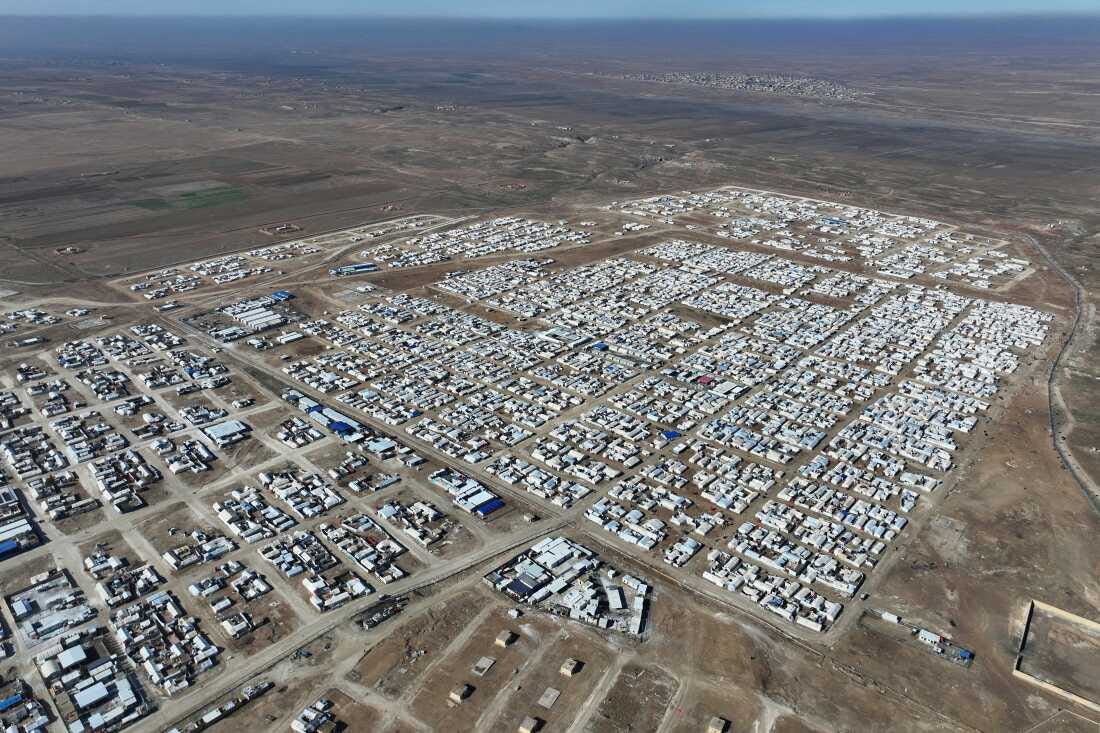
A September 2019 Washington Post report painted a horrifying picture of Al-Hol as a “cauldron of radicalization”, in which hardcore ISIS adherents enforced the group’s strictures upon the wider population through brutal violence, including murder. SDF guards could do nothing but attempt to “contain” offenders physically, while Islamic State’s extremist ideology spread “uncontested”, with tens of thousands of children a literally “captive audience”. The facility was struck by al-Sharaa’s goon squad on January 20th, sending clusters of its captives, and the SDF, fleeing.
Al-Hol is now under government control, the fate of its approximately 30,000 inhabitants uncertain. However, there are grounds to believe the camp’s population was primed in advance to expect, and welcome, the arrival of al-Sharaa’s fighters. Leaked documents expose how The Global Strategy Network, a psychological warfare specialist founded and staffed by British intelligence veterans, has maintained a secret presence in Al-Hol for years, covertly perpetuating MI6-approved propaganda messaging every step of the way.
The putative Syrian government’s destruction of Rojava significantly consolidates its hold on power nationally. The SDF occupied territory is home to the country’s primary oil- and wheat-producing areas, seizure of which provides a sizeable windfall. There is moreover zero prospect of a breakaway Kurdish state emerging, which the territory’s leaders had repeatedly mooted following HTS’ December 2024 capture of Damascus. These developments will be warmly greeted throughout Western corridors of power - first and foremost perhaps, London.
As this journalist has previously exposed, HTS was groomed for years prior to its violent palace coup by Inter-Mediate, an MI6-linked consulting firm run by Jonathan Powell, British Prime Minister Keir Starmer’s national security adviser. Inter-Mediate has maintained a dedicated office within Syria’s Presidential palace ever since. Starmer cheered Bashar Assad’s fall as an opportunity for London to “play a more present and consistent role throughout the region.” That plan is now being put into action.
‘Moderate Version’
The leaked files show Global Strategy began constructing a psychological warfare infrastructure within Al-Hol almost immediately upon its founding, in the wake of Islamic State’s formal March 2019 defeat. Contrary to mainstream reports that the SDF had comprehensively crushed ISIS, the documents note the group continued to conduct “operations” against “military and intelligence assets” in Rojava. This meant “Daesh remains a clear and present danger” locally, “continuing to deploy acts of violence against an ever-expanding list of adversaries.”
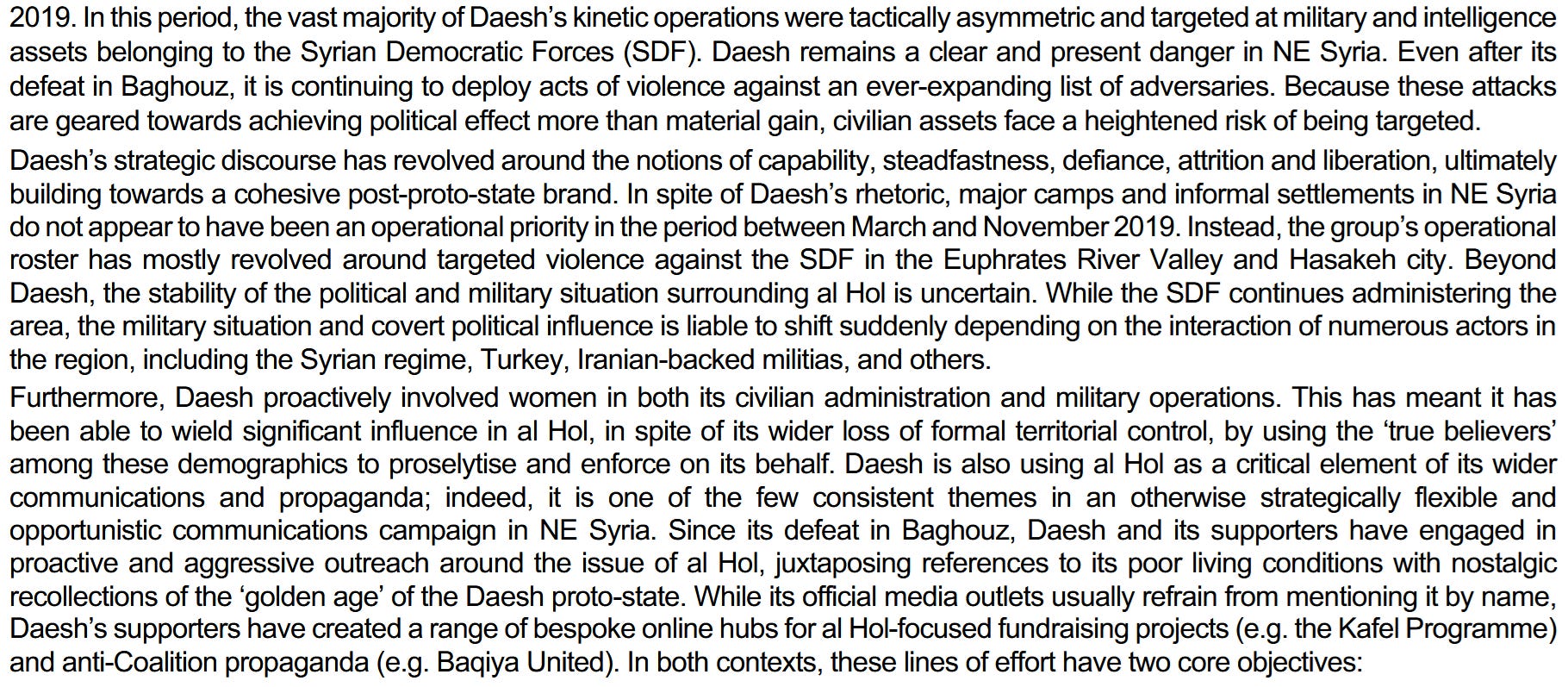
There were other issues making Global Strategy’s mission difficult, and deeply dangerous. As “Daesh proactively involved women in both its civilian administration and military operations,” this meant Islamic State was “able to wield significant influence in Al-Hol, in spite of its wider loss of formal territorial control, by using the ‘true believers’...to proselytise and enforce on its behalf.” The “spectrum” of residents spanning “active Daesh supporters” to those “actively victimised by Daesh” was also said to be “highly complex and unclear.”
Moreover, ISIS bombarded detainees with propaganda, while exploiting Al-Hol “as a critical element of its wider communications,” supporting “proactive and aggressive outreach around the issue.” Some Daesh-distributed imagery juxtaposed “poor living conditions” in the camp “with nostalgic recollections of the ‘golden age’ of the Daesh proto-state.” ISIS leaders also frequently made public statements about Al-Hol, calling the camp’s existence “the worst and most important matter” while urging their supporters “to free [the] sisters and tear down the walls restricting them.”
Despite this, Global Strategy boasted of its ability to maintain a “full-time team presence” in Al-Hol, and beam relentless psyops to inmates via the infrastructure of Western-funded local radio station ARTA. Dedicated local print and social media platforms would follow. The intelligence cutout pledged to create a network of “media centres” throughout the camp, which would serve as “gathering spaces”. There, detainees could cook food, drink tea and socialise, as their children enjoyed a dedicated play area, and varied Global Strategy-concocted programming was broadcast all day:
“[A media centre] provides a social meeting place where [target audiences] can collectively consume and discuss media content, which is more likely to result in the uptake of the information and values.”
This included a “morning show…a multi-segment programme focusing on the camp’s problems and concerns and the work of aid agencies and civil society organisations in the camp, with entertainment breaks and useful community information.” In the afternoons, “a lighter socio-cultural and entertainment programme focusing on local popular culture, as well as useful community information, with entertainment breaks (quizzes, song dedications, horoscopes, etc.)” was transmitted. “Religious” shows were a regular staple too.
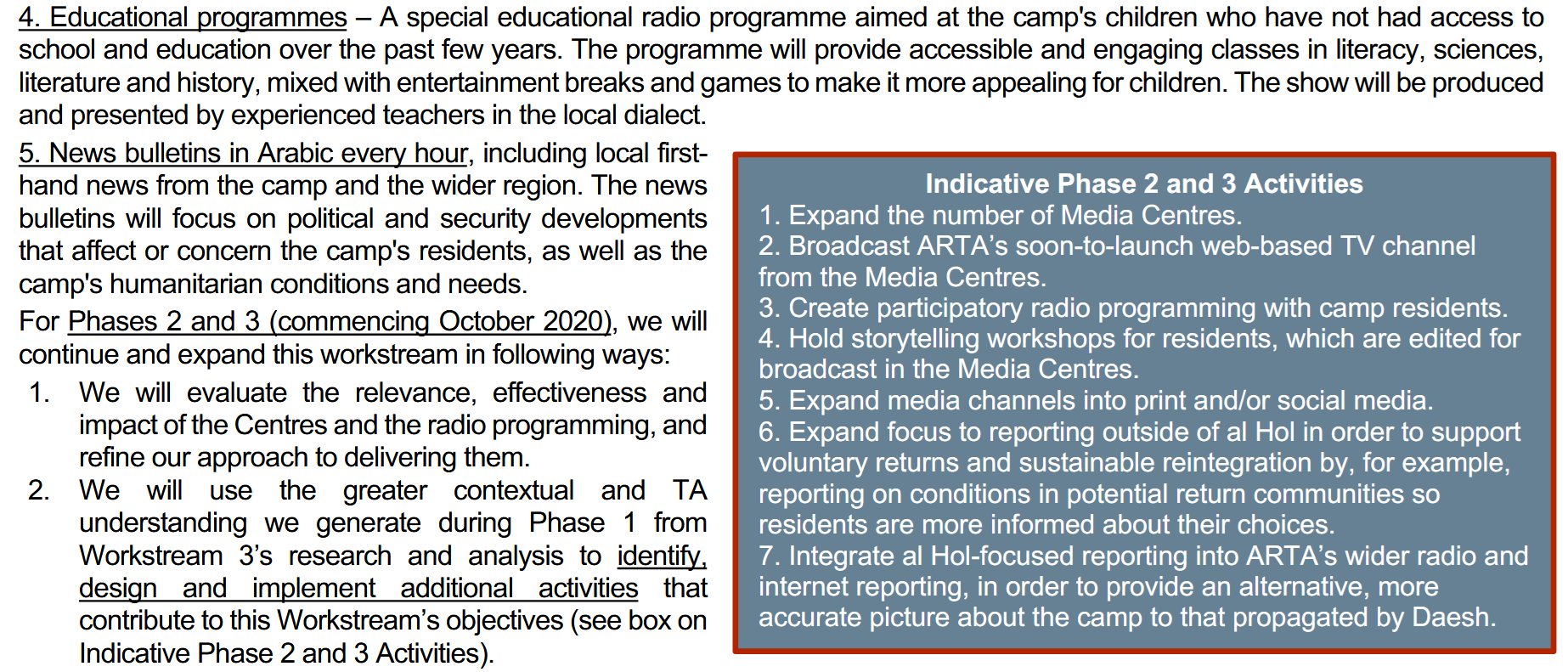
These broadcasts “focused on different questions in Islam and its relation to society,” promoting “a moderate version of Islam” and challenging “extremist ideas and practices, during which moderate local religious figures will be hosted as guests.” Children were considered key targets, with educational programmes providing “accessible and engaging classes in literacy, sciences, literature and history, mixed with entertainment breaks and games.” Vast sums were surreptitiously sunk into this project by British intelligence, without any public oversight or cognisance whatsoever.
‘HTS Domination’
The stated goal of Global Strategy’s clandestine operation in Al-Hol was deradicalisation. To call this effort a failure would be an understatement. From the camp’s creation until the present day, media and think tank reports routinely warned Al-Hol was a key nucleus for the “resurgence” of ISIS. An April 2025 Frankfurt Peace Institute investigation referred to young boys housed at the camp as a “human reservoir” for Islamic State’s “Cubs of the Caliphate” program, via which they were trained in the art of killing.
This begs the obvious question of whether Global Strategy’s objective was truly to counter extremism. The firm’s psychological warfare initiatives have a disquieting tendency to not only actively assist ISIS, but produce the precise opposite effect of that formally intended. For years, Global Strategy managed wide-ranging efforts to “undermine” HTS in the areas of Syria it dominated. However, in leaked documents, the company acknowledged these initiatives were actively assisting HTS’ “growing influence” in the country.
Resultantly, many Syrians regarded HTS as “synonymous with opposition to Assad.” It is surely no coincidence that in September 2025, former-MI6 chief Richard Moore admitted his agency had courted HTS for years prior to its seizure of Damascus. This clandestine bond was struck despite British intelligence being under no illusions mainstream accounts of the group’s split from Al Qaeda were fantasy. A leaked 2020 Foreign Office file noted “HTS domination” actively provided “space for [Al Qaeda]-aligned groups and individuals to exist” in the country.
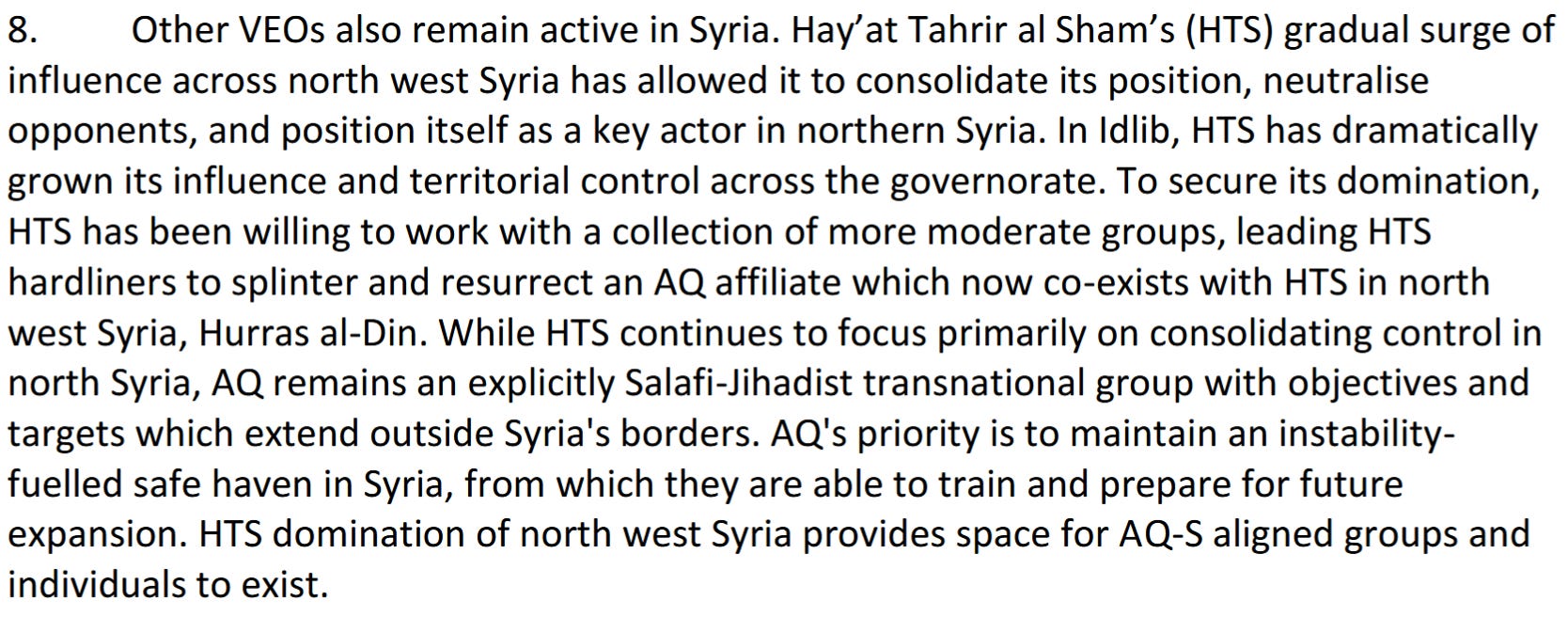
This peaceful coexistence helped Al Qaeda “maintain an instability fuelled safe haven…from which they are able to train and prepare for future expansion” outside Syria. We thus must ask ourselves whether Global Strategy’s actual aim in Al-Hol was to convert detainees to the ‘right’ kind of militancy, from the perspective of British intelligence. The cutout’s unparalleled reach into the camp could easily have been exploited to prepare inmates for the day al-Sharaa’s forces liberated them.
Either way, Syria’s Al Qaeda-affiliated government has now been granted a vast “human reservoir” of grateful former inmates, who can be called upon to assist in brutal crackdowns on internal dissent, massacres of Alawites and other ethnic and religious minorities, and more widely shoring up an ideal Anglo-American puppet state locally. It is not for nothing Damascus was granted a greenlight to capture Rojava at US-mediated talks with Israel in Paris in early January, where al-Sharaa signed a locally-despised accord with the Zionist entity.
Thank you for your incredible journalism Kit! Your ability to find these documents really are second to none.
Another fantastic piece of forensic level of investigative journalism.