

All my investigations are free to read, thanks to the enormous generosity of my readers. Independent journalism nonetheless requires investment, so if you value this article or any others, please consider sharing, or even becoming a paid subscriber. Your support is always gratefully received, and will never be forgotten. To buy me a coffee or two, please click this link.
December 12th marked the 30th anniversary of the Dayton Accords’ signing, which ended the Bosnian civil war after three-and-a-half years of brutal fighting. While consistently hailed in the mainstream as a US diplomatic triumph, the agreement imposed a discriminatory and unlawful constitution upon Sarajevo enshrining division between the country’s three main ethnicities - Bosniaks, Croats, and Serbs - and a Byzantine political system, while carving the country into two separate ‘entities’. Bosnia has constantly teetered on collapse ever-after, sustained purely by prolonged NATO and UN occupation.
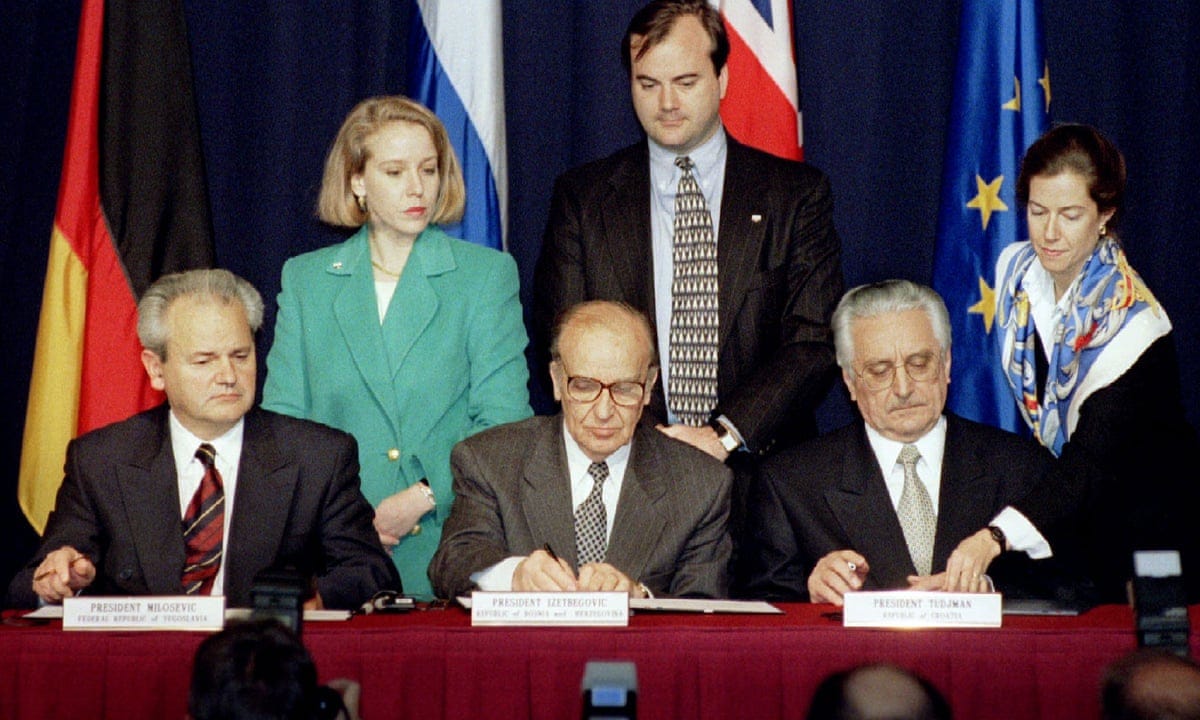
Moreover, the Dayton Accords represented a rank betrayal of Washington’s Bosniak allies. In the conflict’s leadup, the US consistently encouraged them - led by President Alija Izetbegobic - to reject peace talks. After the war’s eruption, the Bosniak leadership was emboldened to keep fighting and spurn negotiations at enormous financial, human, and material cost, strung along by effusive public support from US officials, and covert military assistance. Come Dayton though, the Bosniaks were forced to accept a far worse settlement than any previously proffered. Parallels with the Ukraine proxy war are ineluctable.
The Bosnian conflict’s greatest tragedy is it could’ve been avoided not only without a shot being fired, but no territorial carve-up or ethnic partition of any kind. Before its April 1992 outbreak, numerous attempts were made to reach an equitable settlement negating any prospect of war. In summer 1991, as Yugoslavia was beginning to rapidly disintegrate, representatives of Izetbegovic met with Bosnian Serb leaders in Belgrade, to discuss the then-republic’s future.
The two sides hammered out a simple but ingenious plan. Bosnia would be a sovereign, autonomous, undivided state, in confederation with Serbia and Montenegro. Bosniak-majority territory within Serbia would also be ceded to Sarajevo’s administration. The agreement emphasised the necessity of the republic’s diverse population “living together in freedom and full equality.” Bosnia would remain part of Yugoslavia, albeit under a revised federal system, in which the country’s constituent parts were essentially independent, and “completely equal”.
Serb leader Slobodan Milosevic not only agreed to the plan, but further proposed Izetbegovic be the new Yugoslavia’s first federal President for a five year term, invested with the power to appoint military leaders and diplomats, and serve as the country’s head of state. Izetbegovic’s representatives signed off on the agreement, before returning to Sarajevo. Initially, the Bosniak leader was on board. However, according to numerous sources, Izetbegovic withheld his formal endorsement pending a planned trip to the US.
Upon his return, Izetbegovic rejected the deal. This was neither the first nor last blatant example of Stateside officials torpedoing fruitful peace efforts before, and during, the Bosnian civil war. The conflict itself was triggered by the personal interventions of Warren Zimmermann, US ambassador to Yugoslavia. Echoes of Boris Johnson’s April 2022 sabotage of peace talks between Russia and Ukraine are palpable. In early 1992, in a desperate final bid to prevent conflict, the EU drew up the “Lisbon Agreement”.
Under its terms, Bosnia would be its own country, completely separate from Yugoslavia, divided into “cantons” dominated by whichever ethnic/religious community was most populous locally. Bosniaks and Serbs were allocated 43% of the state’s territory each, and Croats the remainder. The three were to share power nationally, via a weak central government. It was signed by leaders of the republic’s major ethnic groups in March that year.
However, Izetbegovic was concerned the plan partitioned Bosnia into distinct entities, with the prospect its Croat and Serb components could secede thereafter. He voiced these concerns to Zimmerman, who told him, “if he didn’t like it, why sign it?” With that blessing - and the prospect of US recognition of an independent Bosnia, and economic and military support - Izetbegovic withdrew his signature, sparking war. Zimmermann later reflected, “the Lisbon Agreement wasn’t bad at all.” Indeed, it was considerably better than the future Dayton Accords, for all concerned.
‘Military Situation’
Bill Clinton made the Bosnian conflict a core plank of his 1992 Presidential election campaign. Attacking incumbent George H. W. Bush for inaction on the crisis, Clinton proposed a variety of aggressive policies, including arming the Bosniaks to the teeth, and outright US military intervention in the form of airstrikes. Expectation was high Washington’s approach to Bosnia would become considerably more belligerent immediately upon Clinton’s inauguration, if he won the vote.
Clinton’s rhetoric shocked the Bush administration, which branded his warlike pledges “reckless”. Little did the public know, this perspective was entirely in line with US intelligence thinking. A vast trove of declassified files related to the Bosnian war amply demonstrate the CIA and other spying agencies were steadfastly opposed to greater US involvement from the conflict’s earliest stages. After Clinton’s victory, the US National Intelligence Council produced a comprehensive explainer guide for his transition team on the civil war.
The document laid out all manner of issues associated with different strategies Clinton had mulled on the campaign trail. For example, US intelligence assessed how, “even with additional weapons,” Bosnian government forces “could not substantially alter the military situation.” Increasing arms deliveries would produce “greater casualties but no resolution of the conflict,” and “attempting to reclaim all of the territory the Bosnian Serbs now occupy would require massive Western military intervention,” including a ground invasion.
Overall, US intelligence believed “the most optimistic possible outcome” was preserving a “fragmented Muslim-majority state following a partition of Bosnia.” This was the precise substance of a peace plan then-under consideration, drawn up by EU and UN negotiators David Owen and Cyrus Vance. Records of a secret February 1993 meeting between senior US government, intelligence and military officials show attendees were determined to covertly wreck the Vance-Owen plan - which granted Bosnian Serbs 43% of the country - while remaining ostensibly committed to its implementation.
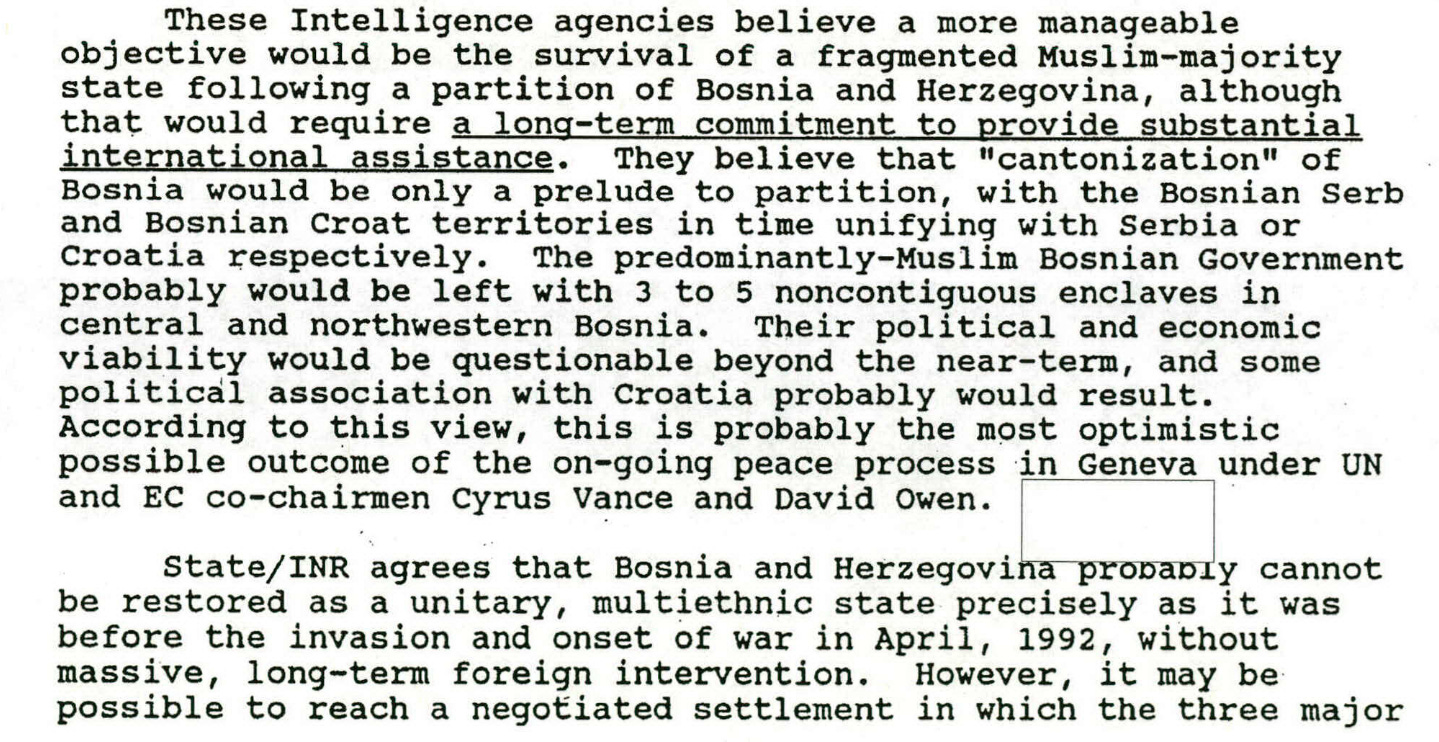
The key means by which Washington ensured Vance-Owen failed was by consistently refusing to publicly rule out military action, while secretly funnelling vast arms shipments - in breach of a UN embargo - and foreign fighters to Sarajevo. US intelligence repeatedly warned the White House such actions steeply increased the Bosnian government’s expectations of subsequent Western military intervention on their side. This meant Sarajevo would be resistant to consider let alone accept peace agreements, even when badly losing the conflict.
US military intervention finally did come, in the form of NATO’s Operation Deliberate Force, an 11-day saturation bombing of Bosnian Serb territory conducted over August/September 1995. This set the stage for the Dayton talks, which commenced November 1st that year, after all sides agreed to “basic principles” underpinning negotiations. Bosniak representatives had every reason to expect the US to unflinchingly fight their corner - but they were in for a nasty surprise.
‘Moral Position’
From the Dayton talks’ inception, it was clear Washington harboured little favouritism towards the Bosniaks. After two weeks, no progress had been made, despite Serb delegate Slobodan Milosevic being eager to make significant concessions. The US also offered Sarajevo numerous inducements, including a controversial program to arm and train Bosniak forces over subsequent years. Central to Izetbegovic’s intransigence was the US-endorsed peace agreement splitting Bosnia into two ‘entities’, with a Serb-majority internal republic - Republika Srpska - governing 49% of the country.
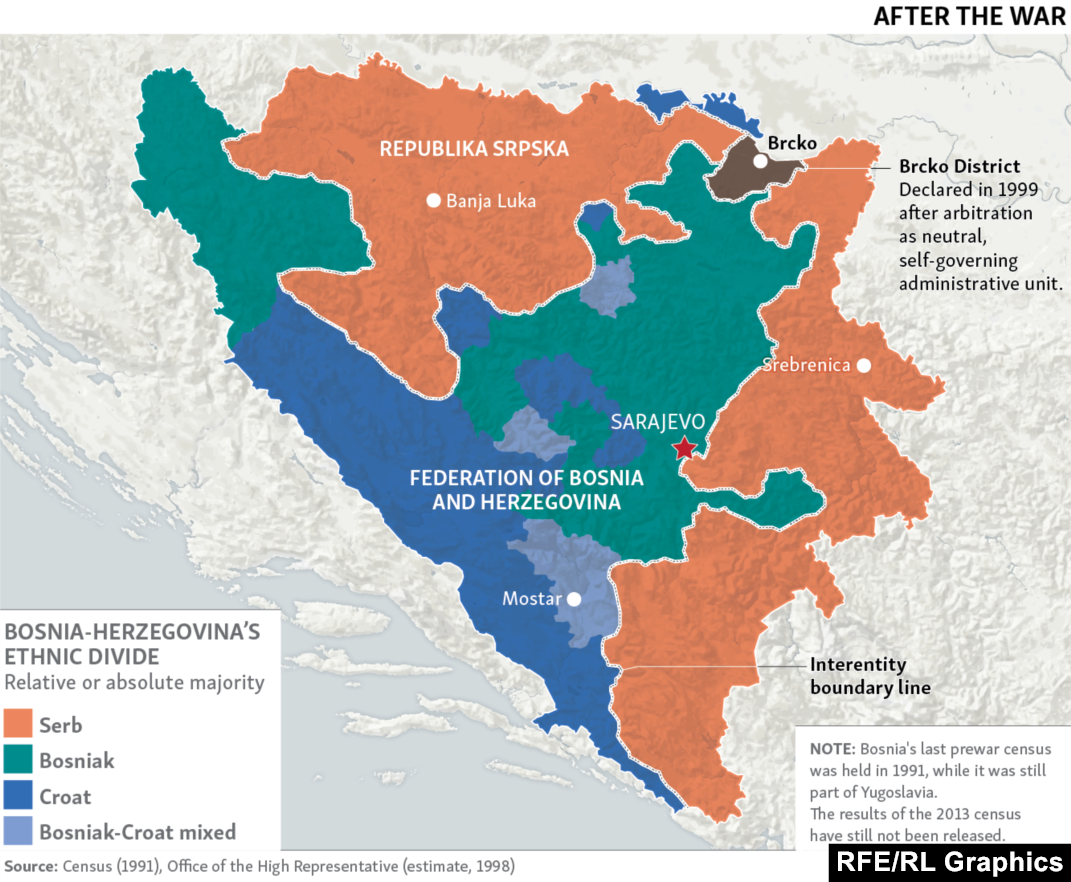
In other words, Dayton handed the Bosnian Serbs more territory than any prior proposed peace settlement, while effectively entrenching the very partition that influenced Izetbegovic’s resistance to the Lisbon Agreement, and produced all-out civil war. His opposition to the Accords was nonetheless battered down by the blunt-force threat of all-out US betrayal if he refused to acquiesce. On November 15th, a series of “talking points” were provided to Clinton’s National Security Advisor Tony Lake, in advance of a personal meeting with Izetbegovic.
Lake was instructed to spell out dire “consequences” the Bosniaks would suffer, if they failed to sign off on the US-dictated peace plan. He would relay how Clinton understood Izetbegovic was in an “extremely difficult” position, but the US President was “disappointed…Dayton has failed to produce agreement” after so much talk. “If we are successful at Dayton, the President will help you make [the] case that peace achieved at Dayton was just,” Lake was directed to say. He would add:
“Territorial proposals are not perfect, but…likely best deal possible. More fighting will be costly with no guaranteed results. Time for peace…Many in [the] US could use failure in Dayton as [an] excuse to disengage from peace process and abandon [the] moral position we have defended to this point.”
If Izetbegovic’s government was “unwilling to complete [a] peace agreement that Serbs can accept” endorsed by Washington, Lake would threaten there would be “no US forces on the ground, NATO implementation, and economic aid and reconstruction package” for Sarajevo. Furthermore, US Congress would not approve, and the Clinton administration would not request, the “equip and train” program for Bosniak forces. UN peacekeepers would also withdraw from the country entirely, meaning “Bosnia could find itself without any form of military support from the West.”
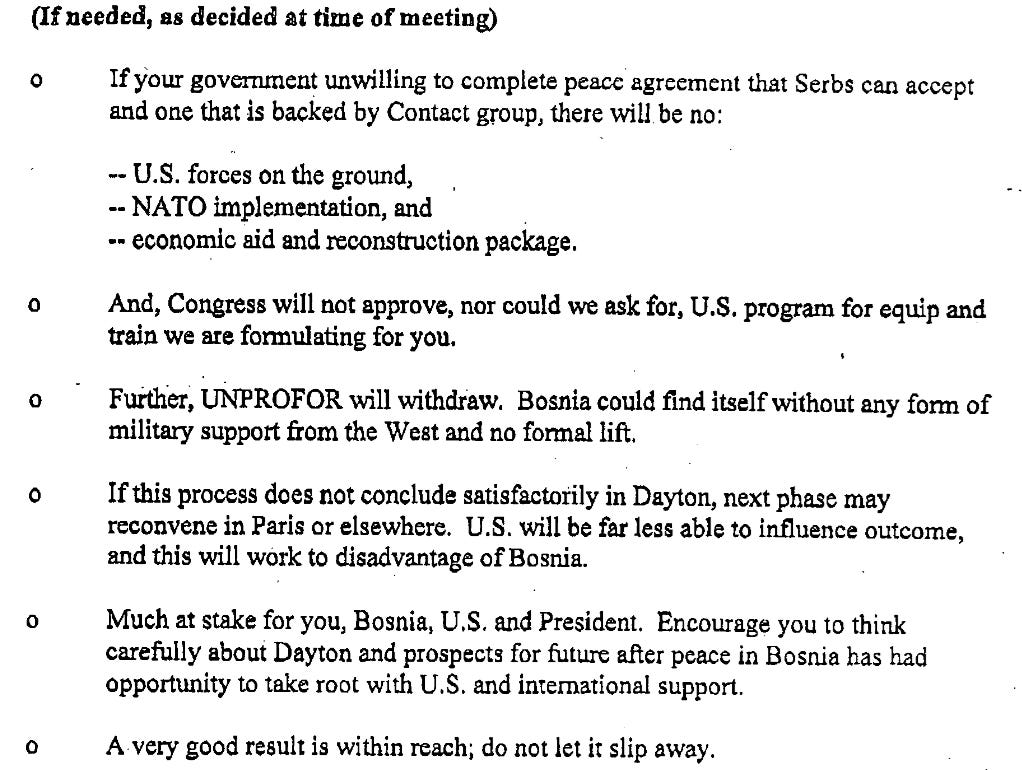
“Much at stake for you [and] Bosnia,” Lake’s talking points for Izetbegovic concluded. “Encourage you to think carefully about Dayton…a very good result is within reach; do not let it slip away.” Successfully coerced, Izetbegovic and his team signed the Accords. Dayton’s terms have been a sore source of contention for Bosniaks ever since. Veteran Bosnian politician Haris Silajdzic, a key Izetbegovic acolyte and Bosniak President 2006 – 2010, has dedicated much of his career to invalidating them.
In a secret March 2007 discussion with the US embassy in Sarajevo, Silajdzic ranted, “we had to sign Dayton with a gun at our heads.” Fast forward to today, and Kiev stares down an identical barrel. Washington pressures Volodymyr Zelensky to accept peace at all costs. This could include major territorial concessions, among other hitherto unthinkable compromises. If only Kiev had implemented the Minsk Accords - and learned the Bosnian civil war’s obvious lessons - this invidious position could’ve been avoided entirely.
This is what the world's biggest country has been doing for nearly a century now: its own doctrine , very consistently over time, dictates that it should spend huge amounts of time and money sowing chaos and discord around the world. In order for it to be relatively more powerful and better able to exploit all others.
So, what spreads down from the shining city on the hill, is; heaps of horse manure and corrosive urine, on the heads of everyone else on the planet. Endless amounts of it.
It's coming up to 36 years since James Baker announced that Soviet troops would be starting to leave East Germany and yet here we are with more European countries than ever with US military bases.
The Trump brokered deal with the Taliban to withdraw US military forces from Afghanistan in 2021 and Brexit gave the Anglo American alliance the confidence and political flexibility to scupper the potential peace deals between the Ukraine and Russia.