

All my investigations are free to read, thanks to the enormous generosity of my readers. Independent journalism nonetheless requires investment, so if you value this article or any others, please consider sharing, or even becoming a paid subscriber. Your support is always gratefully received, and will never be forgotten. To buy me a coffee or two, please click this link.
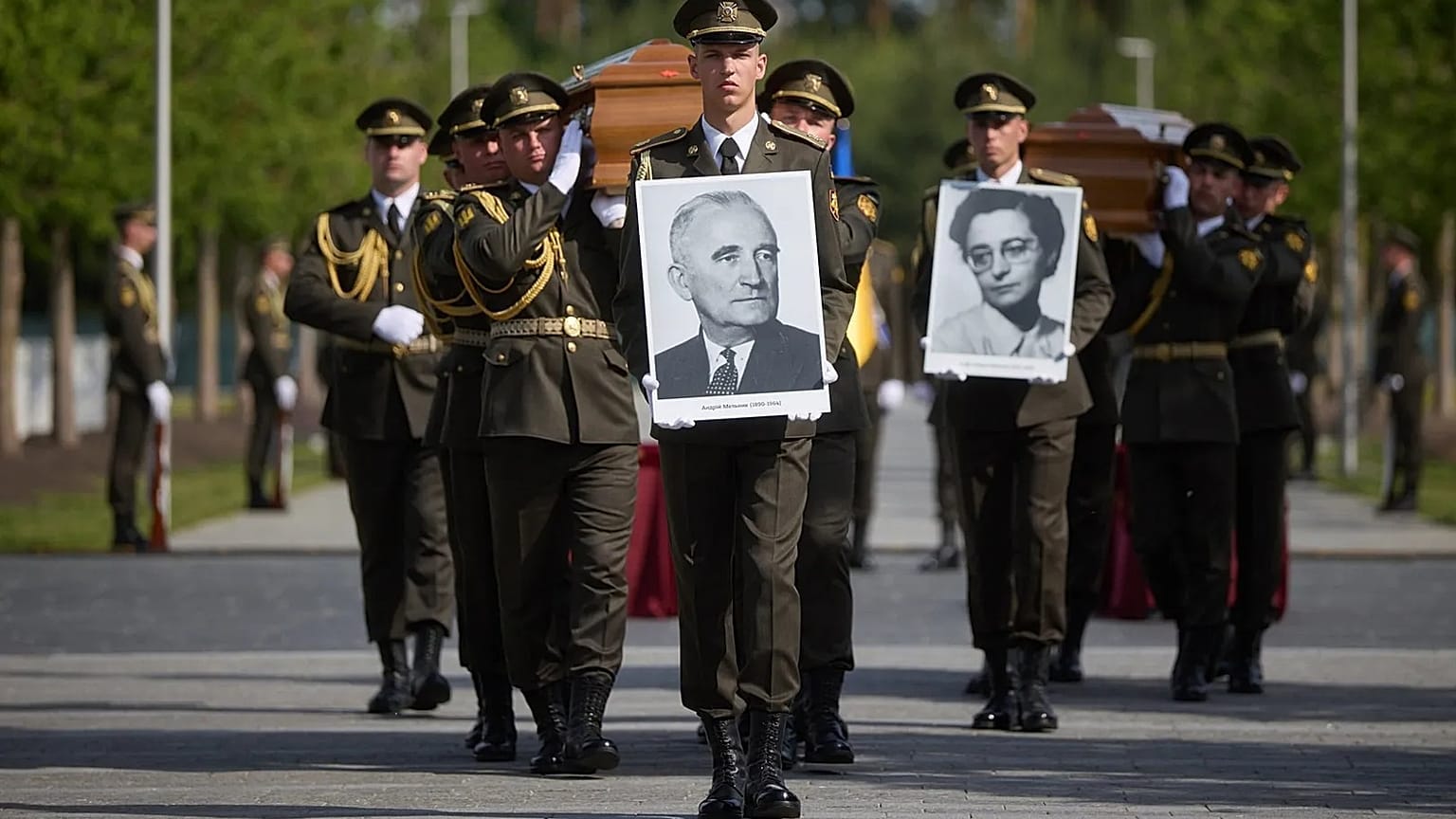
A bitter row has erupted between Kiev and Warsaw, after Volodymyr Zelensky renamed a Ukrainian military unit the “Heroes of the UPA”. The UPA - Ukrainian Insurgent Army - was an ultranationalist faction heavily implicated in the Holocaust, which slaughtered up to 100,000 Polish civilians during World War II. In addition to commemorating the mass-murdering militant group, the corpse of Andriy Melnyk, leader of UPA parent the Organisation of Ukrainian Nationalists (OUN-B), was reburied in Kiev. At a grand accompanying ceremony, Zelensky declared:
“Today we all see that the Ukrainian idea can overcome what once seemed absolutely insurmountable. Now, when we are on Ukrainian soil, under our Ukrainian flag, to the sound of the Ukrainian national anthem, paying due tribute to our Ukrainian heroes, we feel in our hearts everything Ukrainians were forced to go through, everything our people had to endure.”
The unspeakable horrors inflicted upon Poles - and Communists, Jews, Romani and other “undesirables” - by Melynk and his fellow Nazi collaborators were of course unmentioned. So too that the genocidal nationalism practiced and preached by Melynk was covertly promoted and sponsored for decades by Anglo-American intelligence, within and without Ukraine. The ongoing proxy conflict is a direct product of this little-known spectral meddling, which was specifically concerned with promoting cultural and ethnic difference, and enmity, between Russians and Ukrainians globally.
As this journalist has previously revealed, in August 1957 the CIA secretly drew up elaborate plans for a US special forces invasion of Ukraine. Intended to collapse the wider Soviet Union, the Agency’s conspiracy depended heavily on recruiting local fascists as footsoldiers. A significant stumbling block to the Agency’s plot, however, was much of Ukraine’s population actually harbouring “few grievances” against Russians or Communism. “Points of conflict” between Russians and Ukrainians, which could be exploited by the CIA to foment a mass uprising, were scant.
The Agency lamented how “the long history of union between Russia and Ukraine, which stretches in an almost unbroken line from 1654 to the present day,” had resulted in “many Ukrainians” having “adopted the Russian way of life.” Moreover, the similarity of their “languages, customs, and backgrounds,” and the “great influence” of Russian culture in Ukraine, meant the overwhelming majority of Ukrainians felt “little national antagonism.” Yet, the CIA believed “important grievances exist,” and “under favorable conditions” Ukrainians would assist US invaders.
Unmentioned in the invasion planning documents, the CIA had since 1949 been covertly striving to create those “favorable conditions.” A key Agency asset used for the purpose was OUN-B chief Mykola Lebed. In 1943, he proposed to “cleanse the entire revolutionary territory” - today’s western Ukraine - of its Polish population, to prevent any future Polish state from claiming the region. A post-war US Army counterintelligence report branded Lebed a “well-known sadist,” and Nazi collaborator.
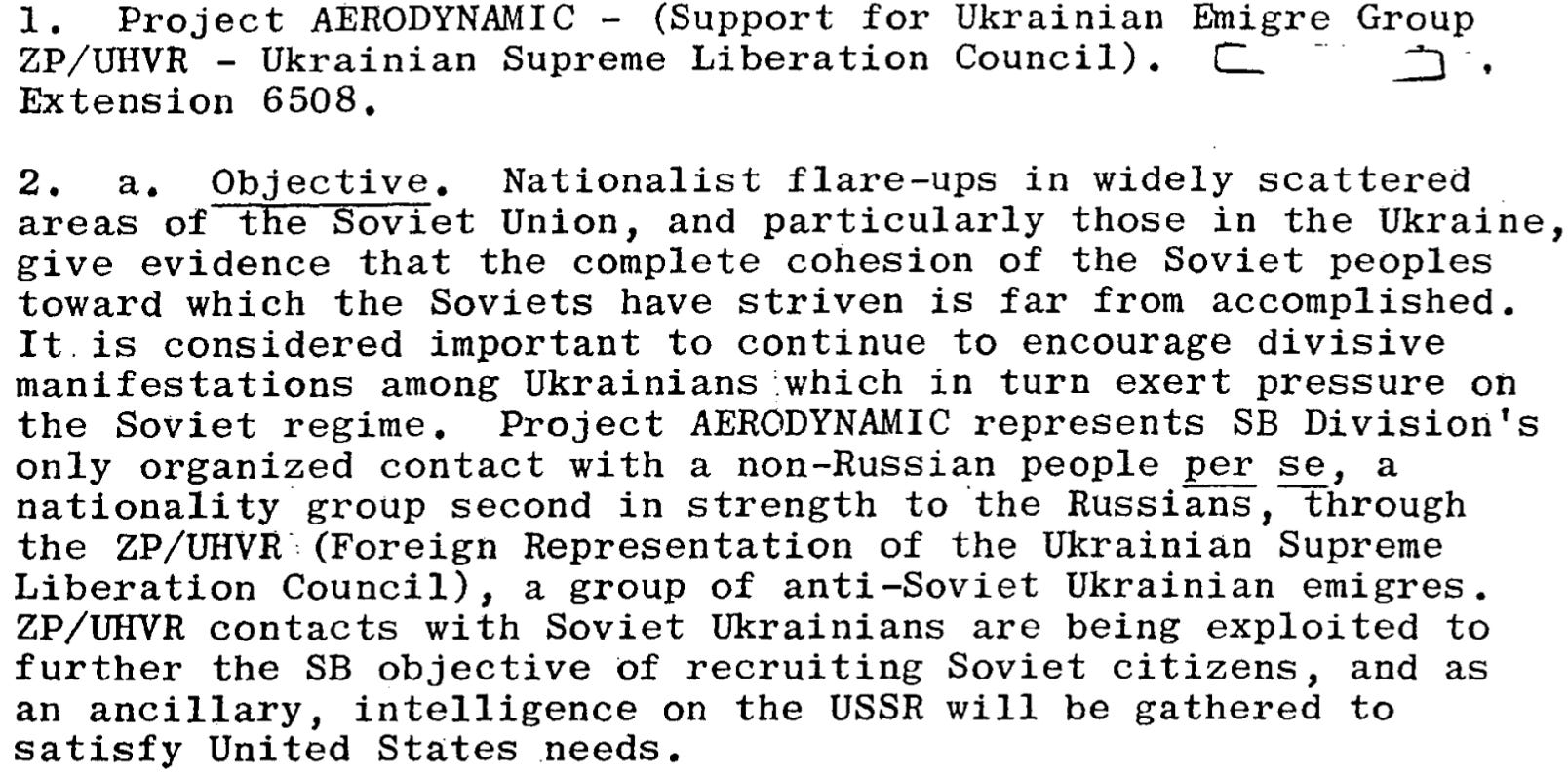
The nucleus of Lebed’s international fascist agitation was Prolog, a New York-based publishing firm. A 1966 CIA memo noted this “cover organization” for the Ukrainian Supreme Liberation Council (ZP/UHVR) was established to conduct “clandestine activity.” It approvingly added that Prolog’s work “contributes to Ukrainian nationalist ferment and to intellectual resistance to Soviet repression by exploiting existing and encouraging new deviationist tendencies” in Ukraine. Elsewhere, the Agency declared it was “important to continue to encourage divisive manifestation” of this sort. The explicitly stated objective was triggering “nationalist flareups” in the USSR:
“[ZP/UHVR] were sent from the Ukraine in 1945 by the Ukrainian Supreme Liberation Council to make contact with Western intelligence representatives and to act in behalf of the homeland…[ZP/UHVR] organized a net of collaborators throughout Western Europe and the United States…the feeling of nationalism is very much alive. ZP/UHVR has proved realistic in its approach to operational matters and its propaganda activity.”
‘Existing Suspicions’
A late 1953 Agency memo documents how the CIA for years broadcast “black radio transmissions” in Ukrainian from a secret CIA installation in Athens, Greece. “Soviet officialdom, Soviet military forces stationed in the Ukraine, the indigenous civilian population…the underground movement and the Ukrainian Insurgent Army (UPA)” were an intended target audience of 40 million people, upon whom the Agency wished to have a “significant propaganda impact.” Produced by ultranationalist emigres who’d fled Ukraine after World War II, the project sought to foment insurrectionary anti-Communist violence:
“Furnish evidence of outside sympathy and understanding for the Ukrainian peoples; intensify anti-regime disaffection by encouraging resentment, bitterness, and distrust of the Soviet regime and its personalities; maintain national consciousness among the Ukrainians and urge them to maintain pride in the individuality and heritage of their culture; create dissatisfaction among Ukrainian military personnel within the Soviet armed forces stationed in the Ukraine; create and intensify dissatisfaction among the Ukrainian civil authorities to the Soviet regime.”
Publicly, the station’s US-made broadcasts - which included Ukrainian folk songs - were “attributed to a notional group of Ukrainian Anti-Communists.” There was no connection “actual or implied, with any established Ukrainian emigre group.” It was of the utmost importance too the CIA’s hand in creating and running the station was concealed - “every effort will be made to keep this risk at a minimum.” However, the operation’s ruinous spoils were considered well-worth the hazards.
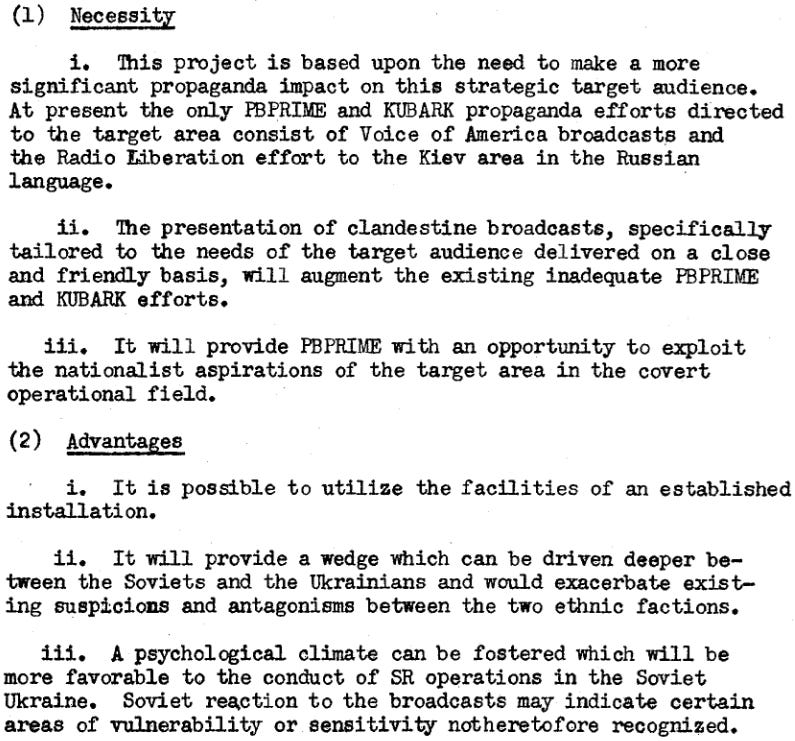
“It will provide a wedge which can be driven deeper between the Soviets and the Ukrainians and would exacerbate existing suspicions and antagonisms between the two ethnic factions,” the CIA declared. The Agency also sought to create a wider “psychological climate” among Ukrainian audiences which would be “more favorable” to other anti-Soviet operations it was simultaneously conducting. Moreover, it was forecast “Soviet reaction to the broadcasts may indicate certain areas of vulnerability or sensitivity not heretofore recognized,” which could be further exploited.
‘Imperial Policy’
The CIA’s efforts to encourage Ukrainian nationalism and separatism endured throughout the Cold War. Via avowed CIA front the National Endowment for Democracy, overt US assistance was provided to Rukh (The People’s Movement of Ukraine). One of Soviet Ukraine’s first opposition parties, Rukh is widely considered to have played a key role in securing Ukraine’s ‘independence’ in December 1991. Four months earlier, US President George H W Bush had visited Kiev and given an infamous speech in which he cautioned Ukrainians against embracing “suicidal nationalism based upon ethnic hatred.”
His comments enraged Ukrainian nationalists, and Stateside anti-Soviet hawks. Yet, Bush’s fears were well-founded. By this point, Yugoslavia was rapidly disintegrating, engulfed by ever-violent fratricidal tensions. His administration was thus formally committed at this time to preserving the Soviet Union in some form, and undertook ill-fated measures in service of this goal. Too little, too late, that mission’s failure set Ukraine hurtling towards all-out conflict with Russia. As long-desired by the CIA, “antagonisms between the two ethnic factions” now run deep.
In a bitter twist, it was precisely because the NED-orchestrated February 2014 Maidan coup was led by rabidly anti-Russian nationalist elements that a majority of Ukrainians did not support the Maidan movement. As a contemporary Washington Post analysis noted, Viktor Yanukovych remained “the most popular political figure in the country,” and no poll conducted to date had ever indicated mass support for the uprising. Surveys conversely showed “large majorities” of Ukrainians opposed the violent storming of regional governments by Maidan insurrectionists.
This hostility was spurred by “anti-Russian rhetoric and the iconography of western Ukrainian nationalism…not [playing] well among the Ukrainian majority.” Washington Post noted how Neo-Nazi party Svoboda was at Maidan’s forefront. Its leader Oleh Tyahnybok had infamously praised the UPA for fighting “against the Moskali [Russians], Germans, Zhydy [Jews] and other scum.” His words were not well-received by the 50% of Ukraine’s population residing in regions that had “strongly identified with Russia” for over two centuries. “Nearly all are alienated by anti-Russian rhetoric and symbols”:
“Anti-Russian forms of Ukrainian nationalism expressed on the Maidan are certainly not representative of the general view of Ukrainians. Electoral support for these views and for the political parties who espouse them has always been limited. Their presence and influence in the protest movement far outstrip their role in Ukrainian politics and their support barely extends geographically beyond a few Western provinces.”
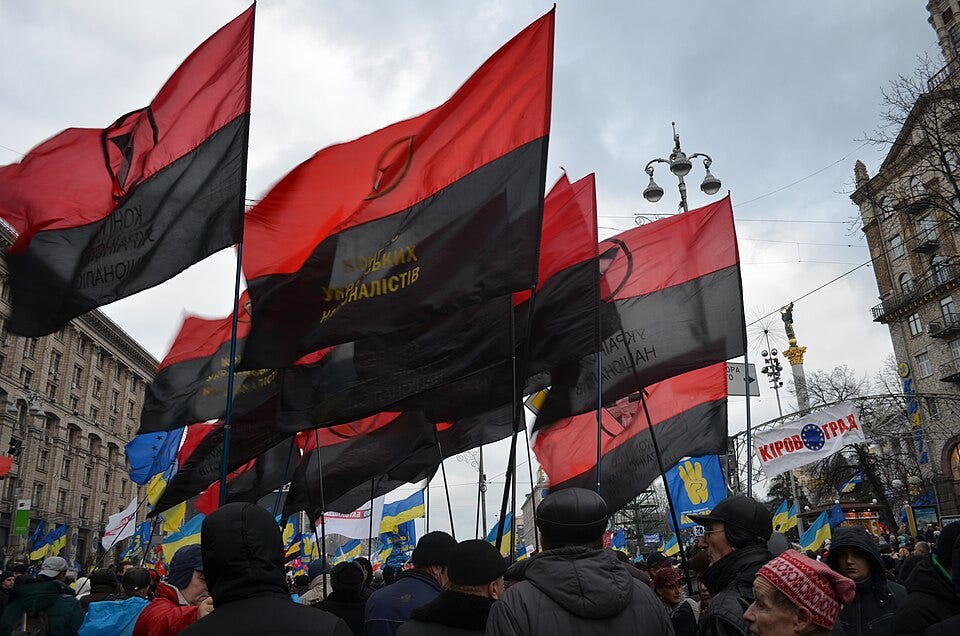
Fast forward to now, and in response to Ukraine’s state-level glorification of the ultranationalist UPA and its lead genocidaire Andriy Melnyk, Polish President Karol Nawrocki has announced he will seek to strip Zelensky of the Order of the White Eagle, Warsaw’s highest honour, bestowed in 2023. Meanwhile, premier Donald Tusk has cursed the Ukrainian leader’s actions as “[wounding] our historical sensitivity,” and “worrying from the point of view of our relations.”
Authorities in Kiev appear entirely unconcerned their close neighbour and proxy war ally has been so egregiously insulted. A Foreign Ministry spokesperson claimed Zelensky had not wished to cause any offence. “Our history confirms only Moscow benefits from disputes between Ukrainians and Poles,” they said. Besides, for Ukrainian soldiers, “the struggle of the UPA symbolises strictly the opposition to Moscow’s imperial policy.” As the CIA always intended, two antithetical versions of history are now effectively at war in Donbass. A more devastating modern day example of divide and conquer in action one would be hard-pressed to identify.
Ukraine was set up to proxy war on Russia.