

All my investigations are free to read, thanks to the enormous generosity of my readers. Independent journalism nonetheless requires investment, so if you value this article or any others, please consider sharing, or even becoming a paid subscriber. Your support is always gratefully received, and will never be forgotten. To buy me a coffee or two, please click this link.
A scandal has erupted after Ed Bearryman, head of the British government’s “influencer unit”, resigned following revelations he was promoted to lead London’s “in-house creative agency…at the centre of government” while under investigation for sexually harassing a female subordinate 15 years his junior. The furore has focused previously scant critical public and media attention on the existence of a dedicated British state agency for managing influencers. Leaked documents reveal how for over a decade, London has covertly and cynically exploited women in these operations.
Bearryman’s evident protection by high-ranking British officials, despite having committed “serious misconduct”, raises obvious concerns about the wider culture of Britain’s hitherto little-publicised influencer campaigns. Bearryman helped establish the New Media Unit in 2024 under Rishi Sunak’s Conservative administration, before being asked by Keir Starmer’s Labour to “overhaul the way [government] communicated with the public,” and reach audiences “unlikely to watch the evening news or pick up a newspaper.” The BBC now reveals Prime Minister Andy Burnham will double NMU’s annual budget, to £25 million.
Mainstream reports on Bearryman’s resignation have credited him with revolutionising government communications strategies, in line with modern advertising, marketing and PR techniques. However, London’s aggressive, covert exploitation of influencers dates back far further. The strategy can be formally traced to spring 2011, during the Syrian dirty war’s earliest days. In advance of expected “international intervention”, British intelligence constructed a nationwide nexus of propagandists to manufacture consent locally and internationally for President Bashar Assad’s ouster, while promoting and whitewashing the foreign-created ‘opposition’.
Countless average Syrians were provided with recording equipment, and trained in video editing, animation and modern propaganda theory. British intelligence-sponsored content they created was fed to Western news outlets, and relentlessly broadcast via social networks, including popular accounts, pages and platforms secretly run by London. A false image was conjured of a popular, progressive Syrian opposition fighting for democracy and human rights, under barbarous attack by a universally despised, genocidal dictator. As this journalist has previously revealed, women featured prominently in Britain’s secret Syrian information war.
Leaked files show MI6 cutout Global Strategy Network specifically trained and managed teams of female reporters “accessing stories that male journalists cannot,” who helped “drive stories into the mainstream.” While their content stimulated “online debate”, reportedly being seen by “many hundreds of millions of people,” the “activity of credible and popular female journalism” was itself an important psychological warfare end. The firm’s female reporters were “key influencers in their own right, appearing several times per week on TV channels” including Al Jazeera and BBC Arabic.
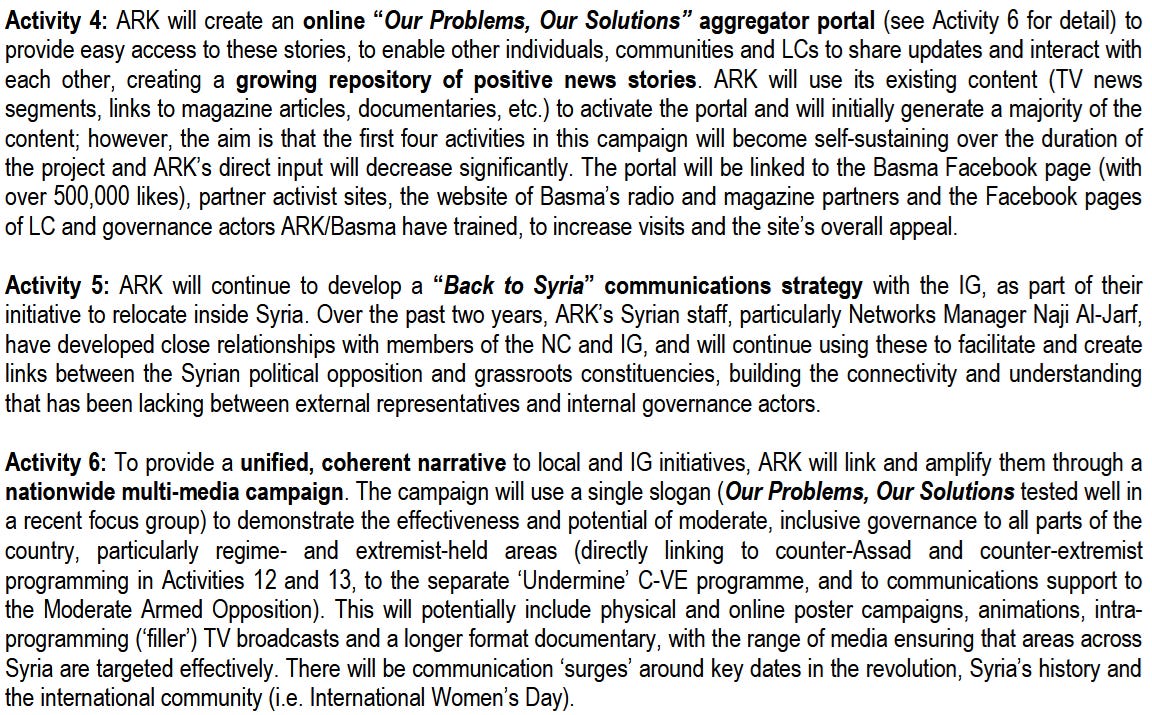
Global Strategy boasted elsewhere of “remarkably high” numbers of women imbibing its covert propaganda output. Several of its campaigns were managed in concert with fellow MI6 cutout ARK - together, they planned “communication surges” around “key dates in the revolution, Syria’s history and the international community,” such as International Women’s Day. ARK’s then-lead on Syrian opposition psyops was Amil Khan. His experiences made him an internationally in-demand “expert” on dark communications arts ever after. Female influencers have frequently been core components of Khan’s psychological warfare campaigns.
‘Human Interest’
As revealed by The Grayzone, within days of the Ukraine proxy war’s eruption Britain’s Ministry of Defence created Project Alchemy, a clandestine military-intelligence cell tasked with keeping Kiev fighting “at all costs.” Khan was immediately tapped to run Alchemy’s “information operations”, targeting Russia. In September 2022, he sketched a grand scheme to “take the first ever all-women Ukrainian team with female leadership from UK to the North Pole while gathering scientific data,” with “professionally managed publicity and media”:
“Footage of the first all women Ukrainian team conquering the North Poll [sic] will captivate the world…Global coverage will send a powerful geostrategic message to Russia that they no longer ‘own’ the Arctic. This grand strategic quick win can catalyse Western efforts to compete with Russia across the Arctic and maintain a Western presence in the new routes between the Euro-Atlantic and the Indo-Pacific.”
The overriding objective was breaking Russia’s supposed “stranglehold on the Arctic,” and securing permission for Khan’s project was forecast to be tricky. He noted Moscow managed “most North Pole activities,” viewing the region as “their area of military influence.” Then as now, “anyone wanting to visit the North Pole for scientific research or adventure must use Russian facilities.” Khan accused Moscow of “often [holding] the expedition community to financial ransom,” by “increasing prices on the spot, or as a political statement.”

Key North Pole facilities for use in Khan’s scheme were all “under Russian control,” with local Ice Station Barneo - “used for science, sport, ski, tourist expeditions purposes” - owned by Swedish billionaire, Frederik Paulsen OBE, owner of Ferring Pharmaceuticals. Khan dubbed him a “close friend” of Vladimir Putin. In reality, Paulsen’s only known contact with the Russian President was his 2008 receipt of Russia’s Order of Friendship in Moscow. Khan moreover outlined a deranged rationale for Ukrainian women visiting the Station:
“Paulsen bought the ice station facilities from the widow of Alexander Orlov, a well-respected Polar traveller. Women are considered a bad omen in the Arctic, especially when in control over Russian men. The superstition is that the ice will crack if women are in control on [sic] the Arctic ice, and Irina Orlova, Alexander’s widow could not reason with the men’s superstition.”
Khan warned how in 2019, “the Russians refused to facilitate the first Ukrainian team to ski to the North Pole for political reasons.” Paulsen’s Ice Station was reportedly “effectively closed…by various delaying tactics and objections until the ice was too dangerous late in the season.” Khan hoped an expedition ostensibly conducting “science programmes” would overcome Moscow’s resistance. Proposed covers for the psyop included “gathering data on the increase of black carbon from Russia’s increased burn off of gas and oil,” or “change in Arctic clouds.”
The influencer psyop’s “strategic outcome” was “news bulletins daily with TV coverage and human interest of the Ukrainian team.” Khan argued his initiative would create “an opportunity for the media [to] use this as ‘a peg’ to expose Russia’s political and commercial aspirations in the Arctic Regions.” His “all-women” Arctic fantasy was never greenlit, for reasons unclear. Which other cockamamie Project Alchemy-affiliated stunts of Khan’s went ahead is an open question. Ukrainians themselves are no strangers to exploiting women to peddle Russophobic, ultranationalist propaganda.
‘Materially Mislead’
For years, Britain’s ubiquitous use of influencers for communication campaigns spanning domestic safer driving and public health initiatives to information warfare waged against ISIS, Russia, and other adversaries remained concealed from public view. Not only was the entire practice itself a closely guarded state secret, influencer efforts were invariably clandestine, their messaging and narratives concertedly “unattributable” to any state or ultimate sponsor. Recently however, government ministers have been entirely overt in their embrace and promotion of influencers as a psyops tool.
This may at least partially reflect how unattributable influencer operations are completely illegal, but have been conducted by London with total impunity for close to two decades. British legislation unambiguously criminalises failing to disclose paid sponsorship of online content, while categorising “any human, animal or virtually produced persona active on any online social media platform” formally as an influencer. They are therefore subject to laws and regulations governing advertising, and related fields. London’s Advertising Standards Agency rules explicitly state:
“If an influencer is paid in any form…and the brand has shared control over the content, the post must be obviously identifiable as an ad…Ads mustn’t materially mislead by omitting the identity of the marketer.”
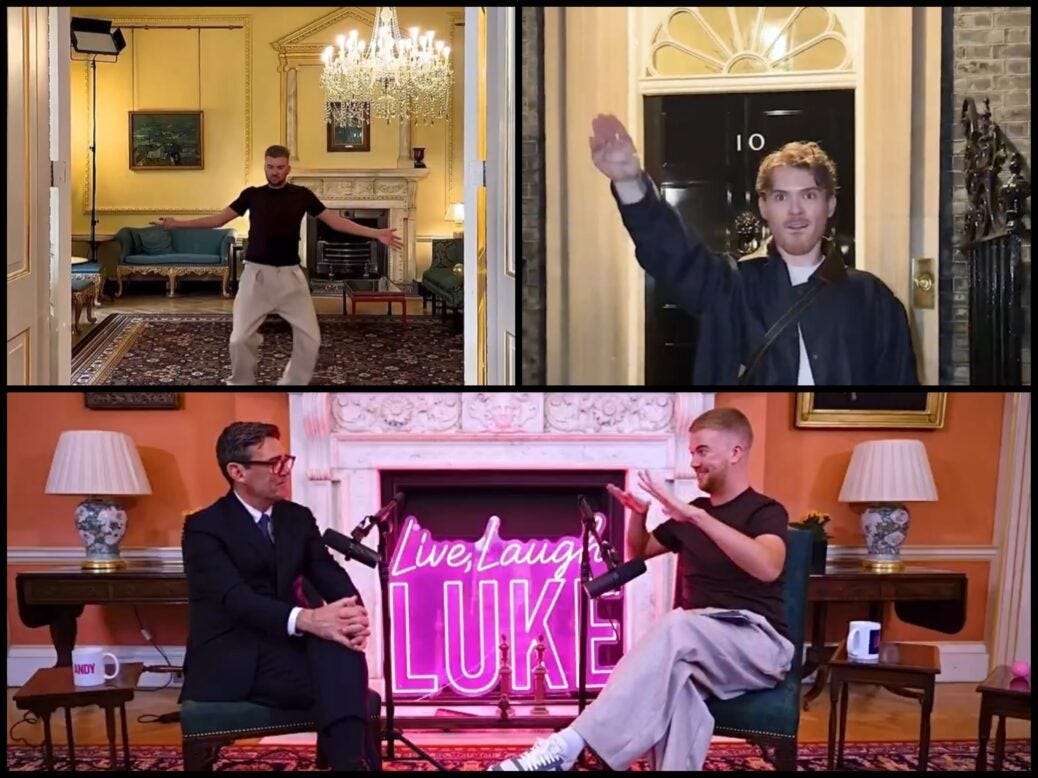
In late November, Andy Burnham invited a group of young TikTokers to 10 Downing Street for a well-publicised, much-condemned official meeting. Widely perceived as crass and desperate by British citizens, media, and politicians, mainstream sources have variously described the spectacle as “demeaning”, “embarrassing”, “grotesque”, and “stupid”. Several critics charge the incident epitomises Burnham’s “government of vibes”, obsessively fixated on positive communications over concrete, tangible action let alone policies of any kind. Yet, these issues date back far further than the current administration.
As this journalist has documented, a January 2010 Ministry of Defence paper called for London to “place considerable emphasis and dependence on the psychological” rather than “the physical”, as the country’s economic, military and political power irreversibly waned. Since then, psychological warfare has been ever-increasingly prioritised by all wings of the British state, and successive governments, at the dangerous expense of tangible, real-world action and capabilities. The grave, inherent issues with this preoccupation are writ large in Amil Khan’s Ukrainian all-female Arctic expedition psyop pitch.
As desired, such a caper would almost inevitably be widely covered by the almost universally pro-Kiev Western media, ever-eager to gratuitously publicise images of young women in any context. Yet, it is difficult to conceive how such coverage would in any way “send a powerful geostrategic message” to Russia, let alone meaningfully dent Moscow’s “stranglehold on the Arctic.” Moreover, were the expedition advertised - or exposed - as a British intelligence-sponsored influencer operation, it would surely invite comparable ridicule to Burnham’s literal embrace of TikTokers.
Given fallen influencer chief Ed Bearryman oversaw programs costing millions barraging audiences globally with intrusive, state-sanctioned messaging without their invitation or consent, it’s seems coincidental his professional undoing was bombarding a female coworker with “unwanted” communications. Likewise, that the influencer psyops pioneered and championed by Amil Khan, Bearryman et al routinely objectify and exploit women as paid propagandists, seems highly relevant. An intensive appraisal of Britain’s use and abuse of influencers, and the psychological impact on practitioners and audiences alike, is urgently required, and long-overdue.
The world is full of sleazeballs - and like scum, they float to the top
Another super incrovertable article by Kit. Lucky we are to have him.