

All my investigations are free to read, thanks to the enormous generosity of my readers. Independent journalism nonetheless requires investment, so if you value this article or any others, please consider sharing, or even becoming a paid subscriber. Your support is always gratefully received, and will never be forgotten. To buy me a coffee or two, please click this link.
In January 2015, the British Army launched 77th Brigade with much fanfare. The new psyops force was openly advertised by mainstream news outlets as a shadow battalion of “Twitter troops… shaping behaviours through the use of dynamic narratives” on social media. After a decade of controversy over the unit’s potentially illegal deployment in domestic and international information spaces however, as of this April 77th Brigade “no longer exists.” Yet, London’s wider clandestine psychological warfare crusade dangerously endures in unseen ways.
77th Brigade’s sudden death was not advertised in any way by the British Army, but serendipitously discovered by a Freedom of Information researcher. Further digging revealed the unit was formally folded into the shadowy Headquarters Land Special Operations Force. Launched in December 2023, it combines special forces operations, reconnaissance-strike capabilities, and digital and information warfare components, arrayed against so-called “hostile states”. It is unclear whether 77th Brigade operates just as before, albeit under a new, less tarnished collective banner.
Either way, Britain’s longstanding, aggressive commitment to information and psychological warfare dominance has not dimmed. In January 2010, the Ministry of Defence published an extraordinary document mapping “Global Strategic Trends” that would shape London’s defence, foreign, intelligence and security approaches for decades to come. With eerie foresight, the appraisal concluded over the next 30 years Britain and the wider West would lose global hegemonic dominance, “as the strategic balance of military power shifts away from the US to a more multipolar distribution.”
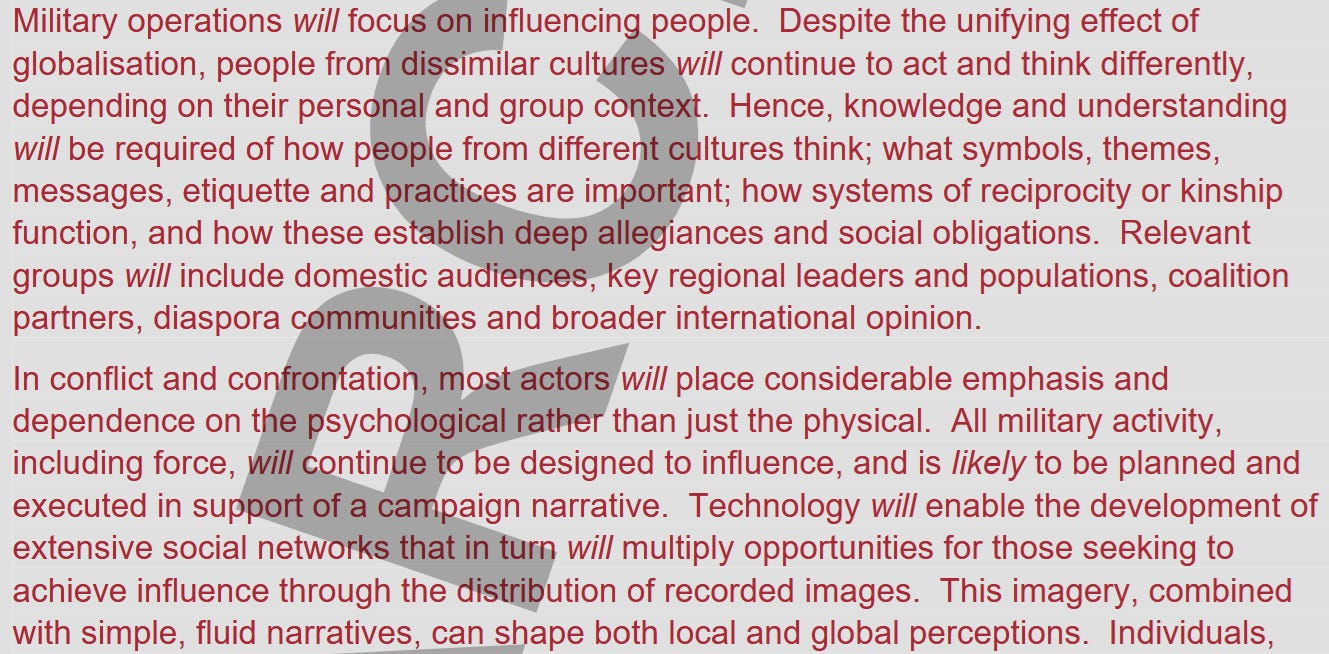
The MOD understood how in turn, London’s ability to “coerce” adversaries “to change their behaviour” via military force faced substantial deterioration, if not outright extinction. It thus befell Britain to “place considerable emphasis and dependence on the psychological rather than just the physical.” The document predicted impending technological innovation would “enable the development of extensive social networks that in turn will multiply opportunities for those seeking to achieve influence through the distribution of recorded images.”
“Imagery, combined with simple, fluid narratives, can shape both local and global perceptions,” the MOD approvingly added. As such, “information and intelligence gathering systems will be required to provide knowledge about people’s perceptions, beliefs and opinions, and how they can be influenced.” The appraisal declared “influence” would be attained by Britain “when the behaviour of the target audience changes through the coordination of all levers of power including military action, words and images”:
“Knowledge will empower and enable, even when the physical contest cannot be won…Influence will not just be about messages or media, but how the combination of word and deed are portrayed, interpreted and understood through the lens of culture, history, religion and tradition. Speed of response is likely to be vital and first impressions will count. Notions such as winning and victory are likely to be of little relevance if an adversary can remain credible in the battlespace of ideas.”
‘Deception Techniques’
The MOD forecast provided a clear blueprint for 77th Brigade’s formation, among many other interrelated cloak-and-dagger British military and intelligence psyops initiatives. More generally, it planted psychological warfare squarely at the heart of London’s policy agenda in all matters domestic and foreign. Spy agency propaganda specialists were and remain duly embedded within every state institution, to advise on the effective use of covert and overt methods of “influence”, “persuasion” and “behaviour change”. Every government communications effort large and small since has relied upon these techniques.
In many cases, these approaches were honed on literal battlefields against adversaries including ISIS and Russia. Their redeployment in a domestic, civilian context was undergirded by a seismic shift in British military and intelligence doctrine. In 2020, a since-memoryholed Army handbook on “information manoeuvre” ominously declared “conflict in the information age” had “removed the traditional distinction between home and away.” In the process, a supposed “grey zone between peace and war” now prevailed. 77th Brigade was said to be “notably” pivotal to this new approach.

As “wars continue to be won in people’s minds,” the internet was cemented as “an integral part of the 21st century battlefield” - a “virtual dimension”. Previously, British Army psychological warfare techniques were “focused almost solely on ‘the enemy’.” However, “with operations now a global spectator sport in an increasingly interconnected world, there are many more audiences to consider.” The “digital playing field” was judged “a powerful way to shape people’s perceptions and behaviour.”
In this new “grey zone”, average citizens the world over were firmly in London’s military psychological warfare crosshairs. The Army’s 2021 Strategic Operating Concept commenced by stating, “the pervasiveness of information and the pace of technological change are transforming the character of warfare.” The document echoed the “information manoeuvre” handbook’s disquieting perspective. Namely, “old distinctions between ‘peace’ and ‘war’, between ‘public’ and ‘private’, between ‘foreign’ and ‘domestic’ and between ‘state’ and ‘non-state’ are increasingly out of date”:
“The triumph of the narrative increasingly determines defeat or victory…hence the importance of information operations. They can be used to support conventional military operations and those utilising proxies and deniable paramilitary forces, military coercion, offensive cyber operations, and of course lawfare. Established techniques, such as assassination, deception, economic coercion, espionage, theft of intellectual property and subversion gain potency through the clever use of cyber, digitised information and social media. Psychological insights into how these channels can be manipulated enhance their effectiveness.”
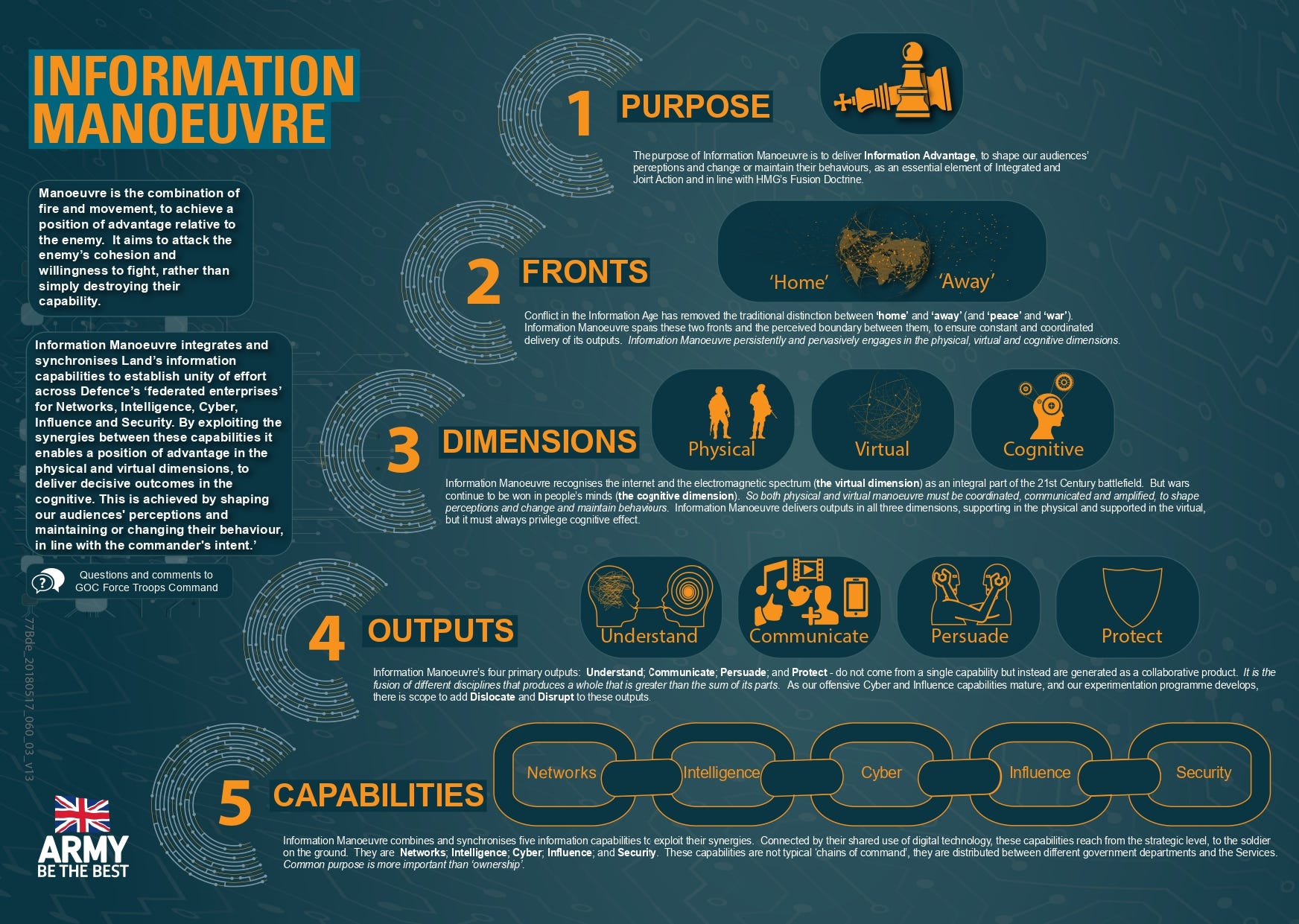
Conveniently, “the pace of technological change and the blurring of ‘peace’ and ‘war’” meant the British Army’s “legal, ethical and moral framework” required updating, to permit London’s psyops warriors to covertly “influence target audiences’ attitudes, beliefs and behaviours” more effectively. By this point, “deception techniques” - “measures designed to mislead adversaries” - had been absolutely fundamental to MOD information operations for several years. Official literature openly refers to “information [being] used to create deception or as ‘camouflage and concealment’,” while training an “unblinking eye” on target audiences.
‘Behavioural Change’
77th Brigade’s malign meddling during the COVID19 pandemic provides a disturbing snapshot of how the unit surveilled and harassed domestic British audiences. 77th Brigade’s centrality to the government’s COVID19 response was revealed by then-Army chief Nick Carter in April 2020. The battalion was said to be “helping to quash rumours from misinformation, but also to counter disinformation.” Subsequent investigations exposed how 77th Brigade deployed a militia of real, fake, and automated social media accounts to disseminate and amplify state messaging, while discrediting dissenters.
A 77th Brigade whistleblower has confirmed “helping root out foreign state misinformation on social media” was a cynical smokescreen, abetting the unit’s brazen circumvention of British law restricting domestic military information operations. In fact, “people expressing dissatisfaction with the UK Government’s action against Covid,” including lockdowns, vaccine mandates and passports, were 77th Brigade’s true prey. The whistleblower emphasised London’s concern was “domestic perception, not national security,” while identifying “levers for compliance with controversial government policies”:
“To skirt the legal difficulties of a military unit monitoring domestic dissent, the view was that unless a profile explicitly stated their real name and nationality, they could be a foreign agent and were fair game. But it is quite obvious that our activities resulted in the monitoring of the UK population…These posts did not contain information that was untrue or coordinated.”
Amply underlining how a veritable psychological war was waged on unsuspecting citizens by 77th Brigade throughout the pandemic, an online profile of a unit veteran notes their work “countering dis- and misinformation during the COVID19 crisis” seamlessly followed “a tour to [sic] the Middle East,” where they “successfully implemented behavioural change strategies against ISIS.” Adversaries in their firing line were average people who stepped out of line not just on COVID19, but a variety of issues, including NATO.
The 77th Brigade whistleblower believed the unit’s domestic psychological warfare and spying operations were “undemocratic, wrong, and should not be allowed to happen again.” There is no indication lessons were learned from the debacle - and every reason to believe comparable campaigns were waged in other Western countries during the pandemic. Leaked documents related to British intelligence black propaganda operation Integrity Initiative refer to the Dutch, Norwegian and Spanish defence ministries receiving secret training from the unit.
This tutelage was conducted under a cloak-and-dagger Foreign Office program formally concerned with “tracking and exposing Russian malign influence and disinformation.” 77th Brigade was heavily inspired in these regards by the Lithuanian Elves, a Vilnius-based volunteer collective ostensibly formed to battle “trolls” and “fake news” emanating from Moscow. As this journalist has exposed, the Elves are covertly managed by Lithuania’s MOD, and engage in offensive cyber operations designed to demonise Russia, Russians, and their supposed sympathisers online. This includes perverse conflation of Communism with Nazism.

Much-hyped in the Western media as a model for states and societies to follow in the name of fighting “disinformation”, the Lithuanian Elves were an early example of how online spaces globally became polluted with rabid, ever-ratcheting anti-Russia sentiment in the years leading up to the Ukraine proxy war’s eruption. 77th Brigade, launched almost simultaneously, was another. The unit’s April reorganisation reinforces how its founding raison d’etre was laying the foundations, and shaping the online theatre, for future conflict with Moscow.
In June 2025, the 2021 Integrated Operating Concept was withdrawn, having been judged longer relevant. The time had come for the British Army’s information warriors to step out of the “grey zone”, and fight a fully-fledged kinetic conflict against Moscow. 77th Brigade made all-out war with Russia a fait accompli with devastating effect, yet British psyops have proven singularly unable to compel average citizens to voluntarily fight. Such are the pratfalls of “dependence on the psychological rather than just the physical.”
Ask 100 british citizens and 99 will never have heard of the 77th Brigade. Once told, 101 of those same 100 citizens will thank God that they are subject to propaganda, lest doubleplus wrongthink ensue.
Lithuania should be abolished