

All my investigations are free to read, thanks to the enormous generosity of my readers. Independent journalism nonetheless requires investment, so if you value this article or any others, please consider sharing, or even becoming a paid subscriber. Your support is always gratefully received, and will never be forgotten. To buy me a coffee or two, please click this link.
From January 11th - 13th, Lithuania marked the 35th anniversary of the “January Events”. Three tumultuous days in 1991 culminated in a widely-publicised mass shooting of protesters at Vilnius’ TV Tower, with 14 killed and over 140 injured. Soviet forces were purportedly responsible. The bloodshed elicited an avalanche of international sympathy for Lithuania, leading to multiple states recognising the republic as an independent country. It was a pivotal event in the USSR’s breakup, and remains widely celebrated throughout the Baltics and beyond today.
Officially observed as the Day of the Defenders of Freedom in Lithuania, in March 2019 a local court found 67 Russian defendants guilty - overwhelmingly in absentia - for the January 13th massacre. Yet, for decades suspicion has swirled there was much more to the incident than met the eye. It has been openly admitted by ultranationalist figures at the forefront of the January 1991 unrest the mass killing was a deliberate ploy in a wider conspiracy to secure Vilnius’ independence, and shatter the Soviet Union.
Audrius Butkevicius, who later became Lithuania’s defence minister, was a chief leader of Vilnius’ battle against Moscow. He has repeatedly admitted that on January 13th, he deliberately directed nationalist activists to positions on-the-ground where they would be shot and potentially slain. In conversations with exiled Baltic Russophone journalist Galina Sapozhnikova, Butkevicius declared: “I accept the responsibility solemnly for us using nonviolent struggle techniques in a situation where people could die.” However, he has consistently blamed the Soviet Red Army for the slaughter.
In 2018, Sapozhnikova published The Lithuanian Conspiracy and the Soviet Collapse: Investigation into a Political Demolition. Her little-known book contains interviews with leading participants on both sides of the “January Events”, and individuals who have dared challenge the established narrative of the time. That Soviet forces cold-bloodedly murdered innocent, defenceless Lithuanians is a fundamental facet of the country’s foundational mythos. In June 2010, Vilnius passed a law criminalising questioning what precisely happened in January 1991, and many have fallen foul of its sweeping terms since.
Politika, a Lithuanian publisher, was raided by armed police in March 2017 under the legislation as it prepared to release Sapozhnikova’s work. Computers and documents were seized, while the organisation’s chief was arrested and interrogated. Local stores were understandably “scared to sell” the book subsequently. Given its contents, law enforcement’s heavy-handed response was inevitable. Multiple interviewees made bombshell disclosures unambiguously indicating the January 13th executions were a false flag, carried out by ultranationalists led by Butkevicius, to be bogusly blamed on Soviet forces.
Perhaps ironically, the most incendiary revelations were proffered by Butkevicius himself. “We knew quite clearly what actions the opponent would take, and hoped for a conflict…for the army to arrive to restore order,” he told Sapozhnikova of the vast protests in Vilnius that triggered the Red Army’s January 1991 intervention, which led to the mass shooting. “But we outplayed them…the tanks rolled in and…foreign journalists and camera crews shot the whole scene,” having been invited by Lithuanian authorities to document local events days in advance.
‘Psychological Warfare’
Butkevicius was an avid disciple and close friend of Gene Sharp. Known as the “Machiavelli of nonviolence”, Sharp was intimately enmeshed within the US defence and intelligence establishment for much of his life. Along the way, he published a number of pamphlets on “nonviolent” protest strategies that have inspired insurrectionary movements the world over, while providing in-person training to countless would-be revolutionaries. As Sapozhnikova writes, Sharp “openly taught” Estonian, Latvian and Lithuanian nationalists “how to dismantle the Soviet Union,” giving lectures in Moscow throughout 1991.
At these conferences, Sharp’s Civilian-Based Defense was circulated to Baltic separatists. Butkevicius has said of the work, “I would rather have this book than the nuclear bomb.” Its contents directly informed their independence struggle. Due to his “interest in psychological warfare,” Butkevicius began exchanging letters with Sharp in 1987. The pair’s connection quickly blossomed. They first met in February 1991 in Vilnius. Come the mid-1990s, Butkevicius worked “for a whole year” for Sharp’s spooky Albert Einstein Institute. He told Sapozhnikova of their bond’s origins:
“Sharp had developed a technique that was able to use large groups of people in acts of civil disobedience. I was getting into politics at the time, so I got interested…Sharp…created a solid theory…designing a real psychological warfare strategy, where civil disobedience is used as a primary weapon…I was happy to be seriously involved in the process. Having medical education with a psychology major, I understood how to use the idea...Once a man stops obeying, the strength of authority completely fades away.”
Sharp was one of many “foreign specialists and political strategists” openly advocating methods for resisting Soviet authority, and collapsing the USSR, within the country itself in its final years. That this was permitted by Moscow is quite extraordinary. Numerous KGB veterans consulted by Sapozhnikova confirmed they were well-aware of machinations by US regime change operatives locally, including CIA apparatchiks, but the Soviet leadership was unconcerned. Alexander Osipov, a Lithuanian KGB counterintelligence specialist, summarised the situation bluntly: “there was a betrayal from [Mikhail] Gorbachev’s side.”
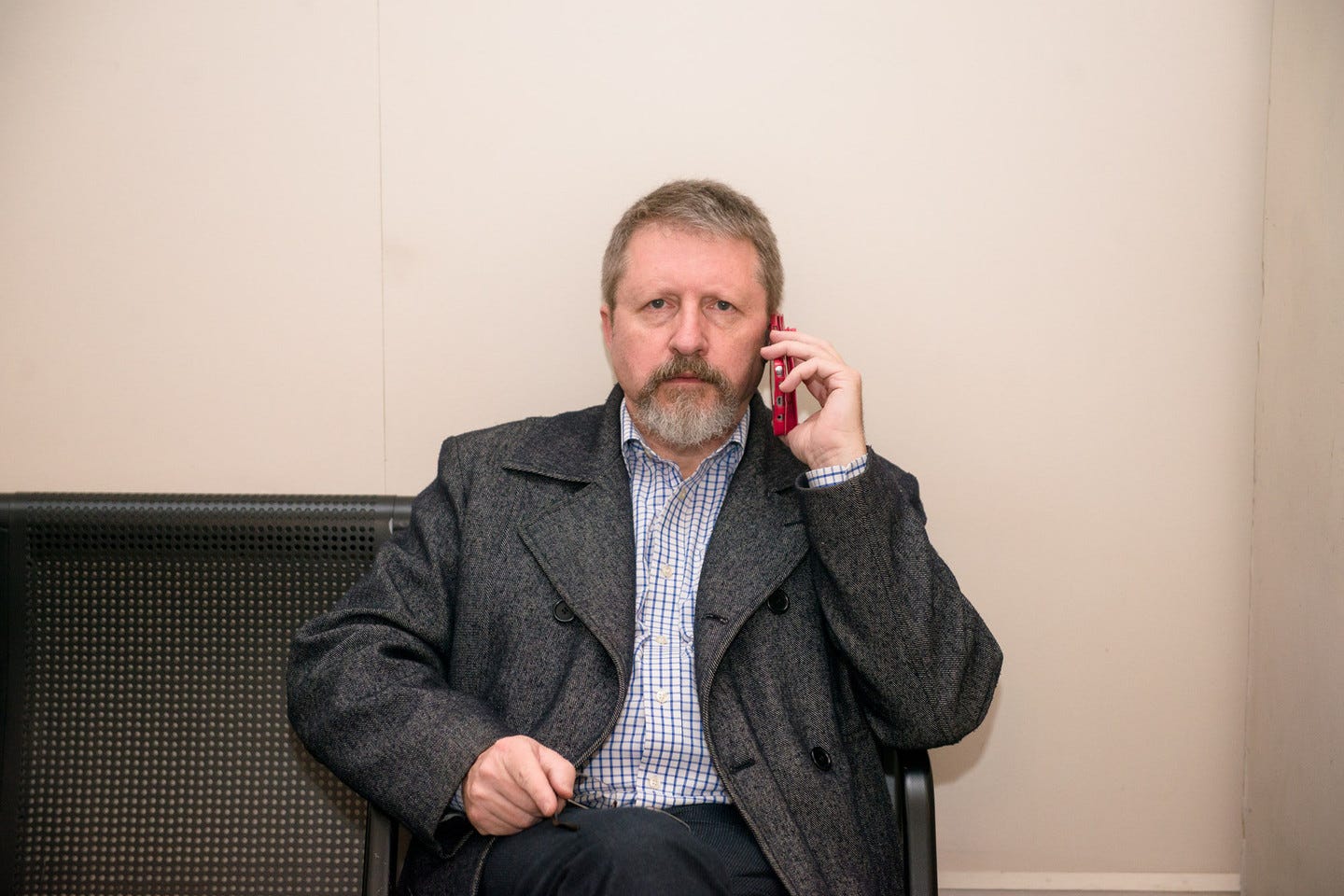
Osipov recalled how from the late 1980s onwards, information on the activities of local counter-revolutionary elements, and their Western sponsors, was “sent to Moscow on a daily basis.” However, his superiors took no action, even when “traitors and treason” were uncovered. If fifth columnists or spies were exposed in agencies and departments of the state, his superiors simply “[recommended] we fire them.” In the summer of 1989, the motivation for this concerted inertia was reportedly “made clear” to Osipov.
During a visit to Moscow, he claims a senior KGB official informed him, “it has been decided to give up the Baltics.” Thereafter, Osipov’s role was reduced to simply “observing the situation” on-the-ground. He witnessed “chaos and pressure” ratchet in Lithuania with some velocity. Regular separatist protests steadily swelled in size to many thousands of people, while local TV was “methodically hammering” the message home to audiences that Vilnius must split from the Soviet Union all along.
In the days leading up to the “January Events”, Osipov and his coworkers “noted the mass arrival of a huge amount of press and assumed that something was about to happen.” A superior warned him to stay at home, “and it would be even better if you had witnesses watching you.” In other words, the risk of local Soviet military and intelligence officials being fitted up for a planned, impending crime of some kind was significant, and well-understood by those in the loop.
Osipov is under no illusions about what occurred on January 13th 1991. “The new government of independent Lithuania needed just a bit more to tip the scales in their favor…In order to finally unite the Lithuanian people, they needed a little blood,” he told Sapozhnikova. “The picture is fairly clear…there are dozens of witness testimonies” indicating people were “shot from above and [nearby] roofs.” These areas were occupied by opposition elements aligned with Butkevicius, not the Red Army.
‘Official Version’
For two decades, it remained an open, unexamined, unspoken secret in Lithuania that Soviet forces likely weren’t culpable for the January 13th 1991 massacre. Mikhail Golovatov, head of the Red Army unit deployed to Vilnius TV Tower, testified in 2004 how “not a single shot was fired from our side,” amply demonstrated by none of their ammunition having been expended during the operation. Moreover, an officer within their expedition was killed alongside Lithuanian civilians, as the unit came under fire from opposition-occupied sites.
It was not until November 2010 the incident became subject of significant national controversy, however. During a radio interview, prominent Lithuanian statesman Algirdas Paleckis publicly declared “our people were shooting our own” on January 13th 1991. A “21st century inquisition” then erupted. Paleckis was prosecuted for “denying Soviet aggression”, the very first person to be charged under the June 2010 law prohibiting critical discussion of how Lithuania became an independent country. He was concurrently subject to relentless media attacks.
At his resultant trial, Paleckis presented 12 separate witnesses who saw opposition “provocateurs” shooting from roofs of buildings at the voluminous crowds below, contrary to the official narrative Red Army soldiers on the ground opened fire. He also provided Lithuanian government forensics reports showing at least six victims were killed by hunting rifle rounds, from a vertical 50 - 60 degree angle. He was found innocent in January 2012, but then convicted upon appeal, and forced to pay a 3,000 euro fine.
Sapozhnikova notes, “there were separate punishments for the witnesses who supported Paleckis and told the court what they had witnessed with their own eyes.” Many people he personally knew from serving as Vice-Mayor of Vilnius, who were encouraged in January 1991 by “burly men” to approach the TV tower killing zone “fearlessly” as the Red Army “only have blanks”, weren’t called to testify. They thus evaded adverse consequences for the high crime of telling the truth.
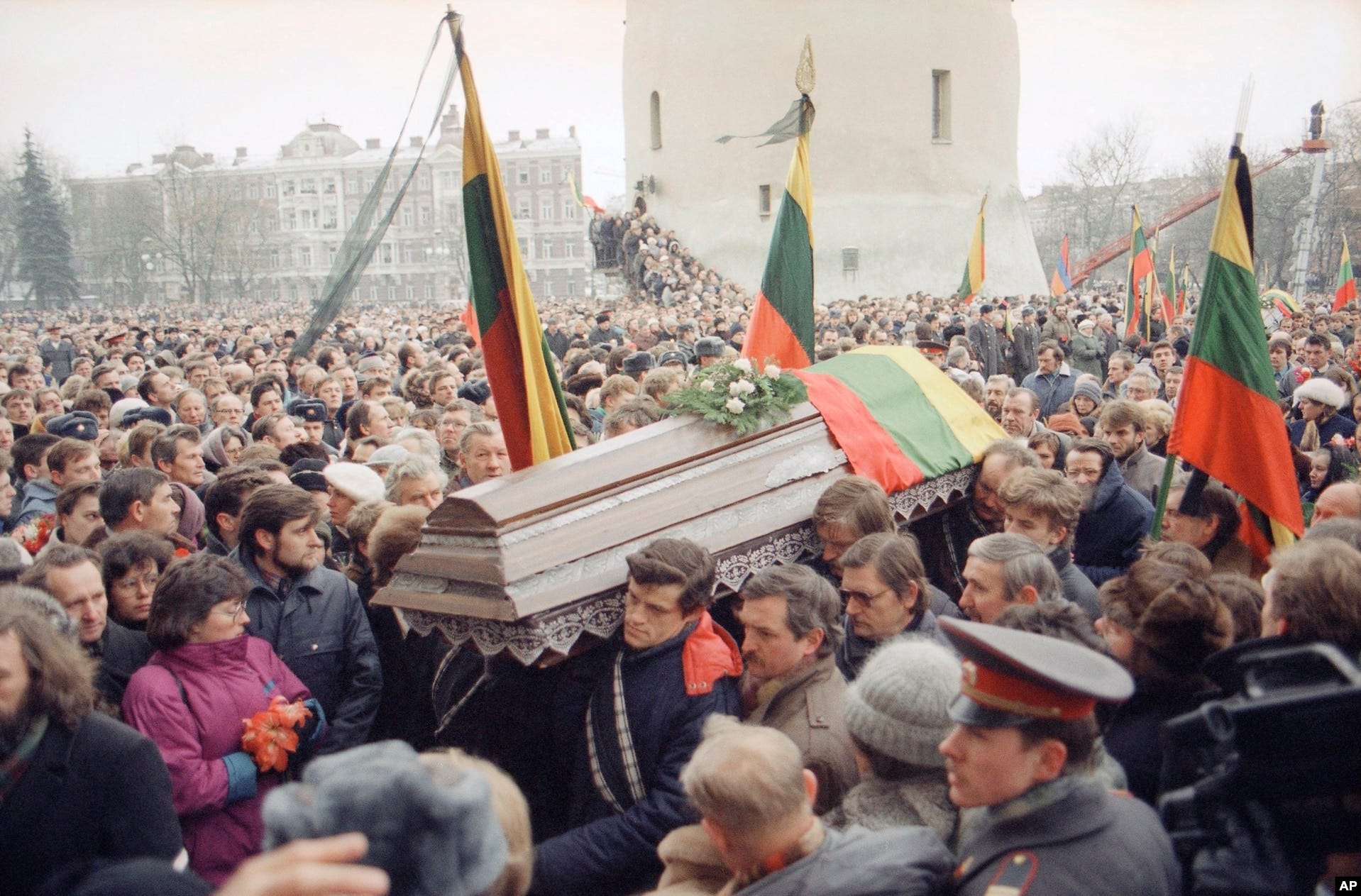
In many conversations with Lithuanians who knew the reality of the “January Events” while travelling through the country, Sapozhnikova enquired “why did you remain silent for so many years?” They universally responded, “because we wanted independence.” Asked why only many years later were people willing to go on record about what they knew, her interviewees typically replied, “because independence turned out to be worse than the Russian yoke.” As Paleckis told the journalist:
“[Lithuanian] politicians have made a religion out of the 1991 incident…That is why millions, if not billions of money were sunk into this version…The official version is very convenient for the current government…There is an enemy - Tsarist Russia, the Soviet Union, and now Putin’s Russia - always harming Lithuania and always at fault for everything. And as soon as economic problems arise in Lithuania, the Russophobia and anti-Communism button is pressed. And the people unite once again, because they have a common enemy.”
‘Nonviolent Struggle’
There is a glaring paradox at the Lithuanian counter-revolution’s core. Butkevicius boasted of the centrality of “Sharp’s books and insights” to the success of the Baltics’ independence crusade, specifically “psychological warfare” and “civil disobedience”. Such was the supposed potency of these techniques, “I could have dragged all of Russia into a war on Communists,” he bragged to Sapozhnikova. Yet, far from “nonviolent”, the “January Events” that all but guaranteed Vilnius’ secession from the Soviet Union climaxed with a hail of bullets, and many killed.
Strikingly, both Butkevicius and Sharp openly admitted to Sapozhnikova “nonviolent” revolutions in fact require violence to succeed. Butkevicius downplayed the January 1991 “carnage”, on the basis “a lot more people would have died” if his separatist clique employed “old guerilla warfare methods.” The Baltics had a history of armed resistance against Communism. For over a decade following World War II, Nazi collaborators and Holocaust perpetrators popularly known as the Forest Brothers waged a brutal, ill-fated insurgency against Soviet authorities, with CIA and MI6 assistance.
Sharp repeatedly spoke affectionately of the Forest Brothers. In conversations with Sapozhnikova, he framed the Baltics’ “nonviolent” independence campaign as a modern version of their guerrilla war. “Nonviolent struggle actually doesn’t mean that you are safe,” Sharp admitted. “It means less people might be killed, than when resorting to violence.” Given “authoritarian governments and dictatorships are very dependent on violence,” when mass movements “begin to threaten them, even using only nonviolent action, you shouldn’t be surprised that the regime will be killing people off.”
Sharp cited the example of CIA-supported Chechen militants, who “unwisely…chose violence to achieve independence,” given Russia was militarily “more powerful” - “it makes no sense to choose armed struggle, when your opponent is that strong.” He declared the genius of “nonviolent methods” was their employment meant “authorities won’t know what to do with you…because if they unleash force, it will cause an immediate international reaction.” Of course, Sharp’s assorted pamphlets conveniently don’t acknowledge the ultimate end goal of “nonviolent” protest techniques is getting activists murdered.
Nonetheless, supposedly government-inflicted citizen deaths and ensuing “international reaction” have been core components of multiple Sharp-inspired colour revolutions and US regime change operations. Sharp was present in Beijing during the April - June 1989 Tiananmen Square protests, and wrote an “eyewitness account” of “nonviolent struggle in China.” He neglected to mention the George Soros-endorsed demonstrators who occupied the Square lynched and immolated several unarmed People’s Liberation Army soldiers, actively seeking to provoke a savage counter-response from authorities. As prominent student protester Chai Ling contemporarily explained:
“The students keep asking, ‘What should we do next? What can we accomplish?’ I feel so sad, because how can I tell them what we are actually hoping for is bloodshed, for the moment when the government has no choice but to brazenly butcher the people. Only when the Square is awash with blood will the people of China open their eyes. Only then will they really be united. But how can I explain any of this to my fellow students?”
That counter-revolution failed. An obvious lesson to draw was the best way “nonviolent” activists can produce bloodshed, and a negative “international reaction”, is to covertly carry out killings themselves. The shooting of protesters by unidentified snipers featured in the April 2002 CIA-backed attempted overthrow of Venezuelan President Hugo Chavez, in numerous countries during the initial stages of the Arab Spring, and Ukraine’s 2014 Maidan Coup. In October 2023, a Kiev court ruling demonstrated beyond any doubt that the massacre was an opposition-executed false flag.
it is heartbreaking for me as a former USSR citizen, especially to read again how Gorbachev's government did nothing against the 5th column and let the country be destroyed. It appears that Gorbachev was put in power precisely for that purpose, to assist in the destruction.
Today, the former USSR republics have fascist and neo-Nazi regimes. The Anglosohere wanted to destroy USSR to establish fascism.
I can't be the only one who immediatley thought about Maidan Square and the revolution of dignity. "Why come up with new tricks, when the old tricks keep working so well?"