

All my investigations are free to read, thanks to the enormous generosity of my readers. Independent journalism nonetheless requires investment, so if you value this article or any others, please consider sharing, or even becoming a paid subscriber. Your support is always gratefully received, and will never be forgotten. To buy me a coffee or two, please click this link.
Over the past two decades, hardline Ukrainian ultranationalists have waged an ever-escalating war on history at home and abroad, with dramatic, world-changing consequences. In the country itself, a highly repressive legal apparatus is increasingly enforcing dangerously skewed narratives of Kiev’s near and distant past, with excessive criminal penalties even for those who unwittingly fall foul of the law. A brazenly politicised battle, it has become turbocharged since the Ukraine proxy conflict’s eruption. Despite widespread opposition, Kiev’s aggressive ultranationalist offensive on history is only intensifying.
These are the grave findings of an extraordinary paper by Ukrainian academic Georgiy Kasianov, “To discipline and punish”: A punitive turn in the memory politics in Ukraine, 2006–2025. As the author notes, the weaponisation of law in service of memory politics is common in Central and Eastern Europe. At least nine countries in the region boast legislation prohibiting public displays of Communist and Nazi symbols, which underpins local ultranationalist efforts - eagerly endorsed by the EU - to perversely conflate the two ideologies as comparable totalitarianisms.
Moreover, in many cases - especially the Baltics - these laws are components of wider cultural and legal ecosystems glorifying Nazi collaborators and Holocaust perpetrators as heroic freedom fighters, while strictly limiting discourse about World War II to conceal local culpability for macabre crimes. As such, Kasianov writes, Ukraine’s “punitive model of memory politics” fits into “a broader post-Communist pattern of state-enforced historical narratives.” Yet, “in its severity, selectivity, ideological and bureaucratic instrumentalization,” Kiev’s war on history “represents a particularly radical and revealing case.”
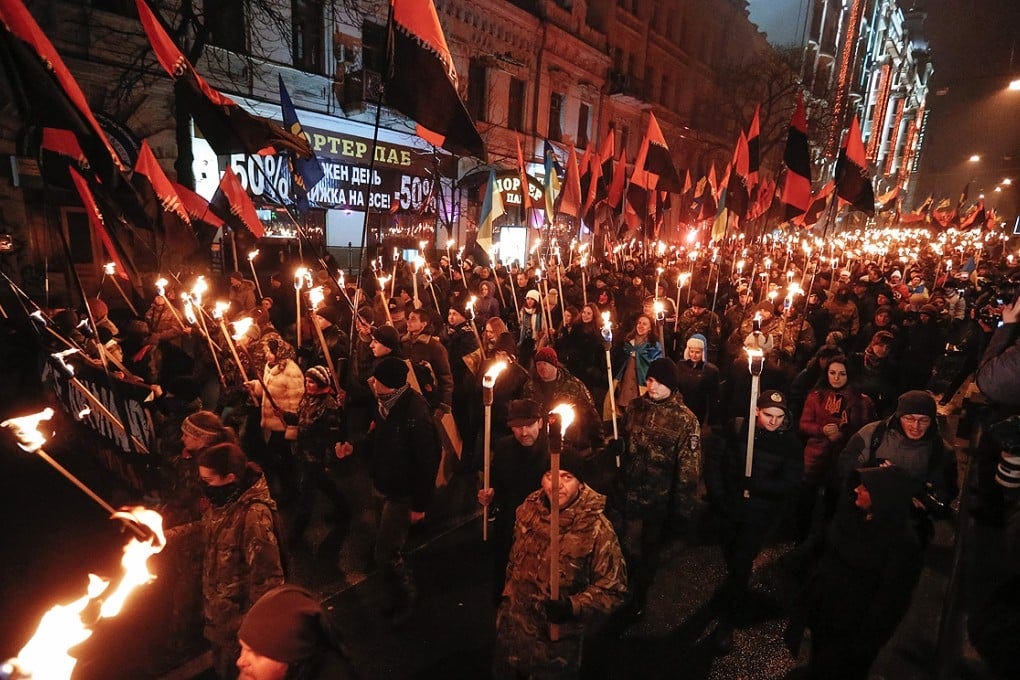
Today, Ukraine “leads Europe in the number of judicial decisions concerning violations of criminal statutes specifically designed to prohibit certain historical symbols,” with criminal penalties for breaching “memory laws” being the continent’s “most severe.” Kasianov traces this state of affairs to the mid-2000s, when Western-installed President Viktor Yushchenko’s government sought to implement laws “institutionalizing” the Soviet Union’s 1930 - 1933 famine as a deliberate genocide of Ukrainians specifically engineered by Joseph Stalin. It is known within Ukraine, and increasingly internationally, as “Holodomor”.
While the famine and resultant mass death was produced and exacerbated by catastrophic human errors combined with adverse natural factors, few historians consider the horror to have been intentional. Markedly, Kazakhs and Russians also perished in vast numbers. As of November 2022, just 23 UN member states have recognised Holodomor as a genocide - most being Kiev’s close allies, post-Maidan. Nonetheless, prominent Western sources state axiomatically the famine was deliberately inflicted, part of a wider ongoing Russian and/or Soviet effort to erase Ukraine.
Meanwhile, ultranationalist claims of how many Ukrainians were supposedly killed by the famine have grown ever-wilder, with some sources placing the figure as high as 10 million. This is several times the multiethnic death toll typically accepted by scholars, conveniently framing the so-called Holodomor as a greater targeted crime against humanity than the Holocaust. Yuschenko’s foray into memory politics contributed significantly to this warped contemporary informational climate. Still, 2006 legislation formally designating Holodomor as genocidal didn’t include punitive measures for denying or questioning that characterisation.
Kasianov documents how over the next 14 years, 13 separate attempts were made to criminalise “Holodomor denial” by ultranationalist Ukrainian elements within and without government and parliament. Each effort sought to impose “a state-sanctioned historical orthodoxy” around Holodomor, while “[constraining] scholarly debate and freedom of expression.” None received approval from parliament’s “legal analytical department”, but ultranationalist memory politics ultimately prevailed on a cultural and political level locally, and beyond. Notably, many of these initiatives were sponsored by the openly Neo-Nazi political party Svoboda.
‘Political Repression’
Svoboda played a substantial role in the Western-orchestrated 2014 Maidan coup, which not coincidentally “created a fertile environment for reframing memory politics as an instrument of state security and ideological consolidation.” The government of Petro Poroshenko justified the “rapid passage of a package of laws aimed at condemning [Communism] and institutionalizing a nationalist historical narrative” as a “necessary defensive measure” and “nation-building project,” countering supposed “external aggression” from Russia. This led to the adoption of hitherto unthinkable legislation in April 2015.
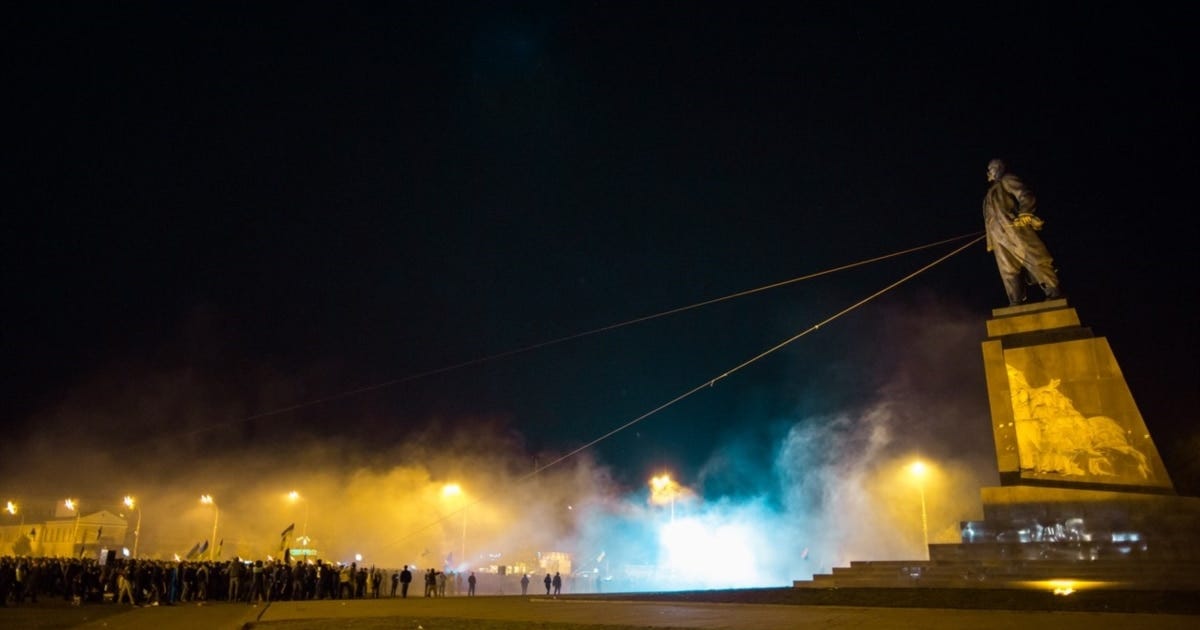
These hastily passed laws equated Communism with Nazism, prohibiting the public display of symbols associated with both ideologies. Yet, Kasianov notes the legislation “also granted legal and moral rehabilitation” to mass-murdering, Nazi-affiliated Ukrainian nationalist factions heavily implicated in the Holocaust. This included Stepan Bandera’s Organisation of Ukrainian Nationalists, and its armed Ukrainian Insurgent Army (UPA) wing. Moreover, despite the law’s formal dual condemnation of Communism and Nazism, Kasianov details how “its implementation and symbolic focus reveal a stark imbalance.”
Approximately 90% of the legislation’s text “is dedicated to defining and enumerating Communist symbols, while Nazi symbols are addressed in relatively minimal and largely perfunctory terms.” Nazi-related prohibitions are “limited to the most universally recognized insignia of the Third Reich, such as the swastika.” By contrast, “the law offers an expansive and detailed catalog of banned Soviet insignia, ranging from the hammer and sickle to red stars and Soviet-era street names.” This “obvious asymmetry” extends even further.
Symbols associated with local Neo-Nazi groups, or formal World War II-era collaborationist Ukrainian military units such as SS Division Galicia, are spared from proscription entirely. “Legal and policy experts and Ukrainian and international human rights organizations” have all expressed concerns over the law’s “vague definitions,” and “potential misuse for political repression.” The Ukrainian Rada’s own “expert department” found the legislation conflicted with Kiev’s established constitution, and numerous existing domestic laws.
Disproportionately harsh punishments for infringements, with offenders facing prison sentences of up to five years along with property confiscation, also drew widespread criticism. A lawyer and lecturer at Lviv National University strikingly compared the penalties involved to “using a guillotine to treat a headache.” A damning open letter signed by a welter of academics and policymakers dubbed the legislation “an instrument of ideological purification, selectively targeting the symbols and narratives associated with the political left while allowing for the implicit valorization of radical nationalist traditions.”
These devastating indictments were dismissed by the law’s advocates as “Kremlin propaganda”, if not outright treason. Kasianov reveals how “principal architects” of Poroshenko’s “Decommunization” agenda were a coterie of ultranationalist “memory activists”, drawn from the Lviv-based Center for Research on the Liberation Movement, and Youth Nationalist Congress. Both maintain “close ideological and organizational ties” with, operating as “facade organizations” for, the Banderite OUN. The pair have long-served as “conduits for nationalist reinterpretation of 20th century Ukrainian history and strong anti-Communist and anti-Russian policies.”
‘Memory Regime’
Post-Maidan, “several leading figures from this milieu assumed influential positions within state institutions, shaping historical policy.” This included extensive infiltration of the Ukrainian Institute of National Remembrance (UINP), the state body charged with implementing memory laws. Then-Deputy Prime Minister Oleksandr Sych of Neo-Nazi Svoboda appointed OUN-linked figures to influential positions within UINP. Not coincidentally, Sych cofounded the fascist, pro-Maidan Congress of Ukrainian Nationalists, an OUN-B “political facade”. Once their long-sought anti-Communist legislation was enacted, enforcement came thick and fast.
From November 2015 - spring 2016, almost 52,000 toponymical objects, 32 cities, 955 villages and settlements, and 25 administrative districts were renamed, with 2,389 monuments and memorial plaques to “totalitarian leaders” dismantled. In all, 1,320 were Lenin statues. Between 2015 and 2021 too, Ukrainian police and the general prosecutor’s office registered 334 criminal cases against citizens related to the display of “totalitarian symbols” - “the vast majority of which concerned Communist imagery.” Details were almost invariably farcical.
In May 2017, a student narrowly avoided jail for posting Lenin quotes on Facebook. Under his plea deal, he publicly expressed “sincere remorse”, while his personal copy of Karl Marx’s Capital was destroyed. In June 2019, an unemployed man received a one year suspended prison sentence for wearing an old T-shirt featuring the Soviet coat of arms while washing windows. In March 2021, a Lviv resident was sentenced to one year’s probation after being “detained by politically vigilant local citizens” for wearing a USSR emblem.
In the meantime, further legislation was passed by Kiev sacralising ultranationalist historical narratives. Lack of political pushback was in no small part assured by Ukraine’s Communist party being banned in December 2015. The same openly fascist and Neo-Nazi elements behind Poroshenko’s “Decommunization” push successfully sponsored laws granting OUN and UPA genocidaires official combatant status and veteran benefits. Now insulated from legal consequences for any atrocities they committed, Ukrainian state sources universally describe them as “heroes” who fought for their country’s “independence”.
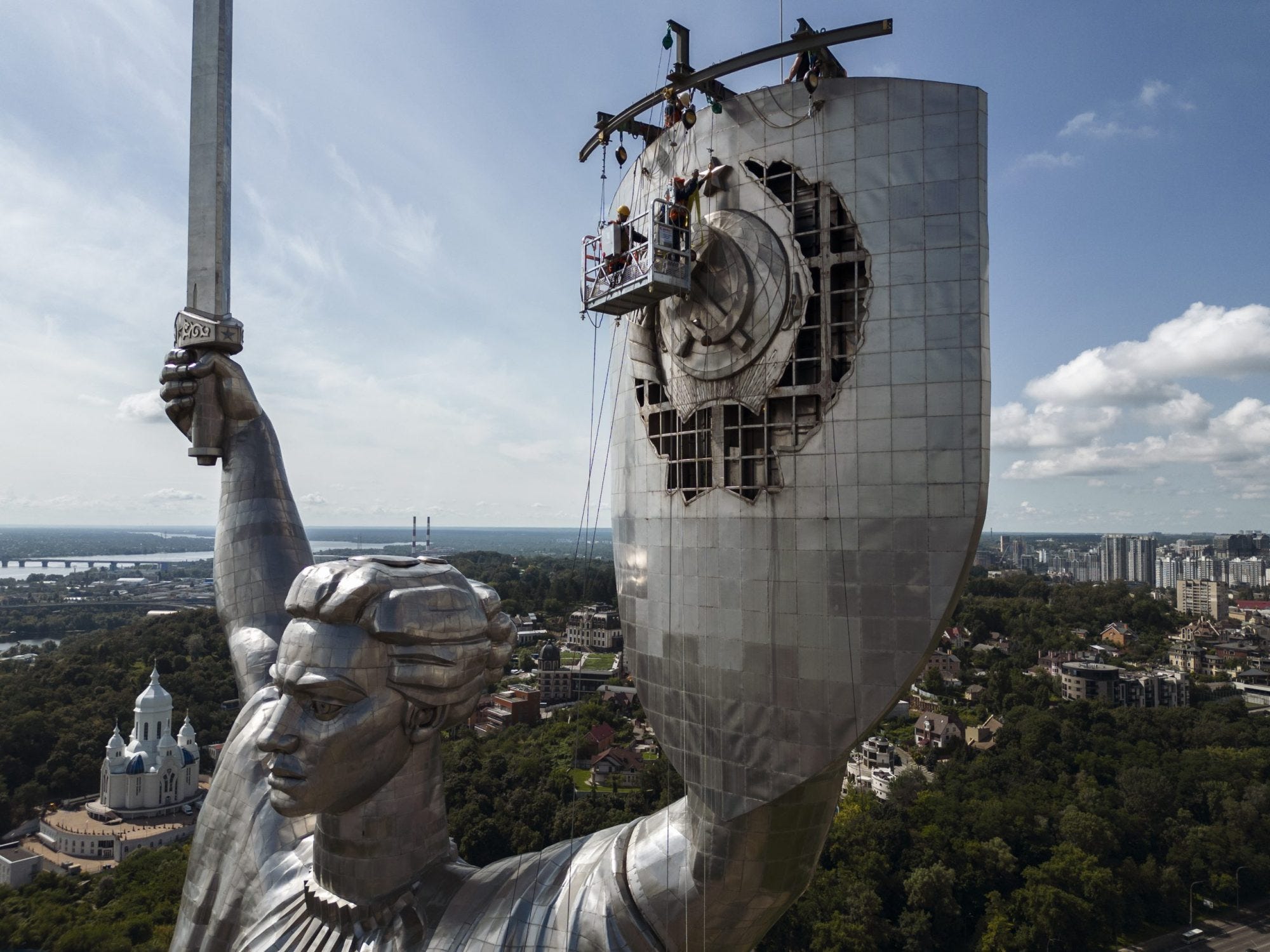
The volume of cases brought under “Decommunization” laws, and severity of the punishments involved, ratcheted significantly following the Ukraine proxy war’s eruption. Authorities were handed an ideal rationale for further assaulting history, while waging war on enemies within, under the guise of “derussification and decolonization.” In keeping with the “near-absence of prosecutions for Nazi-related offenses” pre-conflict, in over 300 criminal cases brought to trial 2022 - 2025, fewer than 10 involved Nazi symbols. The vast majority “concerned the dissemination of prohibited [Communist] symbols on social media platforms.”
Today, even simply liking social media posts featuring Soviet symbols can land Ukrainians in court. Kasianov notes how “case materials” have “indicated the emergence of specialized investigators…focused on monitoring digital communications and online content,” within the ranks of both police and the SBU security service. Concomitantly, there has been an ever-rising growth in “vigilant citizens” reporting acquaintances, coworkers, and neighbours to authorities for breaching Kiev’s stringent memory laws. “Overwhelmingly”, individuals “from marginalized and impoverished segments of the population” have been targeted.
Ever since Maidan, Kiev’s “punitive memory regime” and “nationalist identity project” has been wholeheartedly embraced and promoted by her Western proxy sponsors. No wonder - the legally-enforced, distorted narrative Ukraine is fighting a battle for its very existence, and ultimate liberation from “Russian imperialism”, ensures the war will continue in perpetuity. All along, distorted “memory politics” becomes more entrenched and rabid at the country’s highest levels, leaving Ukraine’s population - and the wider world - at the mercy of a dangerous and deranged ultranationalist clique.
The parallel between Ukraine and Croatia is also interesting, as the latter has likewise enacted laws that—under the label of "totalitarian ideologies"—lump communism and Nazism together, while at the same time, local forms of Nazi iconography are becoming increasingly visible in the public sphere.
Of course fo the Ukrainian regime and its sponsors in the west, history is of interest solely to the extent that it can be weaponized in the present.
What does anyone propose to do about it? The West is strong and therefore its lies are repeated as settled fact.