

All my investigations are free to read, thanks to the enormous generosity of my readers. Independent journalism nonetheless requires investment, so if you value this article or any others, please consider sharing, or even becoming a paid subscriber. Your support is always gratefully received, and will never be forgotten. To buy me a coffee or two, please click this link.
The May 11th resignation of Christian Schmidt, Bosnia and Herzegovina’s High Representative, has elicited little mainstream interest. However, his departure is an absolutely seismic development, which could shatter the brittle peace that has endured in Sarajevo since November 1995, when the Dayton Agreement was inked. Schmidt’s abrupt exit raises urgent questions about the future of Washington’s ongoing occupation of Bosnia, which has provided a beachhead for EU and NATO penetration locally for three decades. It could prove an extinction event for Western hegemony as we know it.
Dayton imposed upon Bosnia a highly discriminatory constitution, enshrining ethnic division. Much of its contents have been successfully challenged in the European Court of Human Rights. Additionally, Bosnia boasts a mindbogglingly Byzantine political system, frequently described as the world’s most complex. The country is split between Bosniak and Croat-majority Bosnia and Herzegovina - representing 51% of Bosnian territory - and Serb-majority Republika Srpska, encompassing 49%. Both have their own governments and parliaments, with their own powers.
Bosnia also has three Presidents, representing the country’s Bosniak, Croat, and Serb populations. Passing legislation at a national level requires unanimity, which seldom happens. Sarajevo’s High Representative is truly in charge. They neither have fixed terms in office, nor are nominated or elected by Bosnia’s population. They aren’t even Bosnian, but Europeans appointed by the 55-country-strong, Dayton-created Peace Implementation Council. Their power is extraordinary. Veteran British politician and former MI6 officer Paddy Ashdown was known as “Viceroy of Bosnia”, while serving as High Representative May 2002 - January 2006.
Ashdown regularly dismissed state officials - including elected politicians - and barred them from holding office, if they refused to adopt a Western-directed agenda in all matters domestic and foreign. In June 2004, 60 Serb officials were defenestrated en masse. That December, Republika Srpska’s Prime Minister and most Serb representatives in Sarajevo’s national government were likewise sanctioned, after unified Bosnia was rejected from NATO’s “Partnership for Peace” program, typically considered a precursor to fully-fledged alliance membership.
The Wall Street Journal contemporaneously framed Ashdown’s actions as “overruling voters to save democracy.” As the BBC now reports, “subsequent holders of the office were far more low key.” Washington’s focus during this time was directed away not just from Bosnia but the wider Balkans, having established Europe’s biggest military base in Kosovo for use in the “War On Terror” against West Asia. Bosnia’s leaders were granted a significant degree of autonomy. This newfound freedom threatened unified Bosnia’s continued existence.
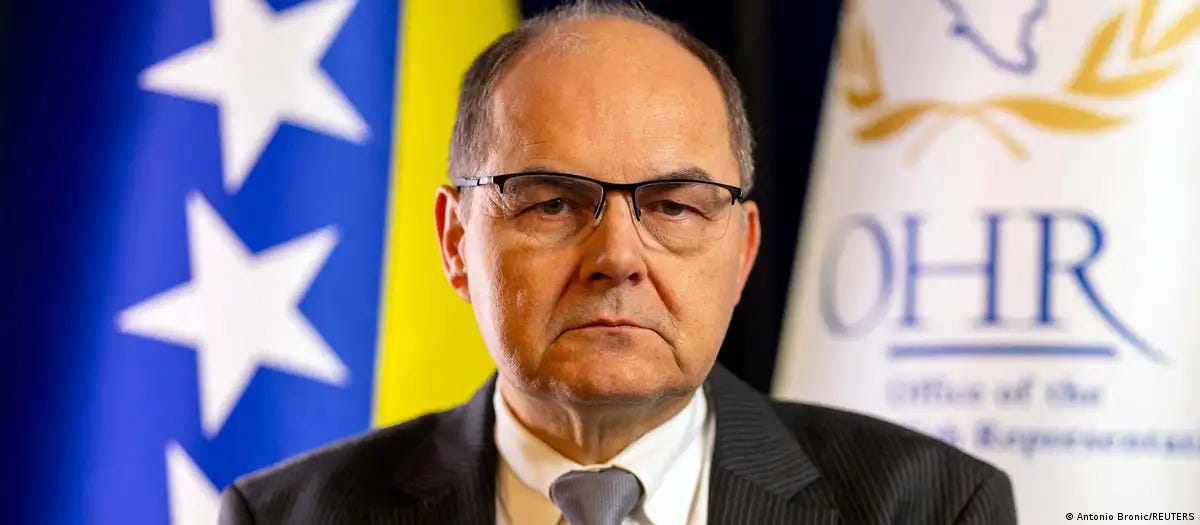
Quickly, Republika Srpska moved towards independence. Per the BBC, “failure” of Ashdown’s successors to push back against Bosnian Serb secessionism resulted in Schmidt taking a “more activist role” as High Representative, from 2021 onwards. After battling Trump-supported Bosnian Serb leader Milorad Dodik throughout his term, Schmidt has capitulated. Republika Srpska could now move determinedly for independence, potentially precipitating a cataclysm for which Europe isn’t remotely prepared. Yet, the US was always going to leave eventually.
‘Peaceful Separation’
Dayton was forged in the aftermath of an August 1995 NATO bombing campaign, which ended the Bosnian war after three-and-a-half horrendous years. Afterwards, the US and Western allies constructed a pliant colonial administration in ravaged Sarajevo. Tens of thousands of military alliance troops dismantled what remained of Bosnia’s socialist-era economic and political system, at literal gunpoint. Meanwhile, the Agreement specifically allocated billions in US ‘aid’ spending for over 20,000 foreign NGOs to assist in reconstruction. As a 1998 report on the foreign influx observed:
“Thousands of international diplomats, human rights workers and soldiers now run this country-in-the-making as a virtual protectorate, with Americans by far the weightiest presence. Together, they write the laws, provide security, determine monetary policy and broker deals on everything from mosque construction to the colors of the national flag.”
At this time, many mainstream outlets sounded alarm over the culture of forced dependency being imposed upon Bosnia via NATO occupation. Nonetheless, that year a high-ranking US diplomat in Sarajevo reported how he had informed American officials in the country and back in Washington to “forget about exit strategy,” as there wasn’t one. Western allies - including Britain, Germany, Israel, Saudi Arabia and Turkey - duly expanded their own influence locally, under the umbrella of US suzerainty. Washington had seemingly bedded down in unified Bosnia in perpetuity.
However, in the NATO bombing’s leadup, behind-closed doors Bill Clinton’s administration was not only preparing for a short-lived engagement in post-war Sarajevo, but considered Republika Srpska’s eventual secession inevitable. Clinton made the Bosnian conflict a central component of his 1992 Presidential election campaign, and the administration spent much of its first term in office mooting outright intervention against the Serbs. Nonetheless, US officials had little concern for their Bosniak allies or a unified Bosnian state in the long-run.
The bombing was intended to strengthen Sarajevo’s negotiating position in subsequent peace talks, rather than entrench a unified Bosnia. A declassified July 1995 US National Security Council paper stressed the importance of impressing upon the Serbs pre-Dayton “the amount of autonomy their republic would have” within a divided post-war Bosnia, and their ability to maintain a “parallel special relationship” with neighbouring Serbia subsequently. Moreover, Washington’s Bosniak allies would be lobbied to contemplate their state’s future dissolution:
“If necessary, we would press the Bosnians to agree that the Serbs can conduct a referendum on secession after two - three years…We would argue that, if the Bosnians cannot persuade the Serb population their best future lies in reintegration, there is no point in blocking the peaceful separation of the union along the lines of the Czechoslovak model.”
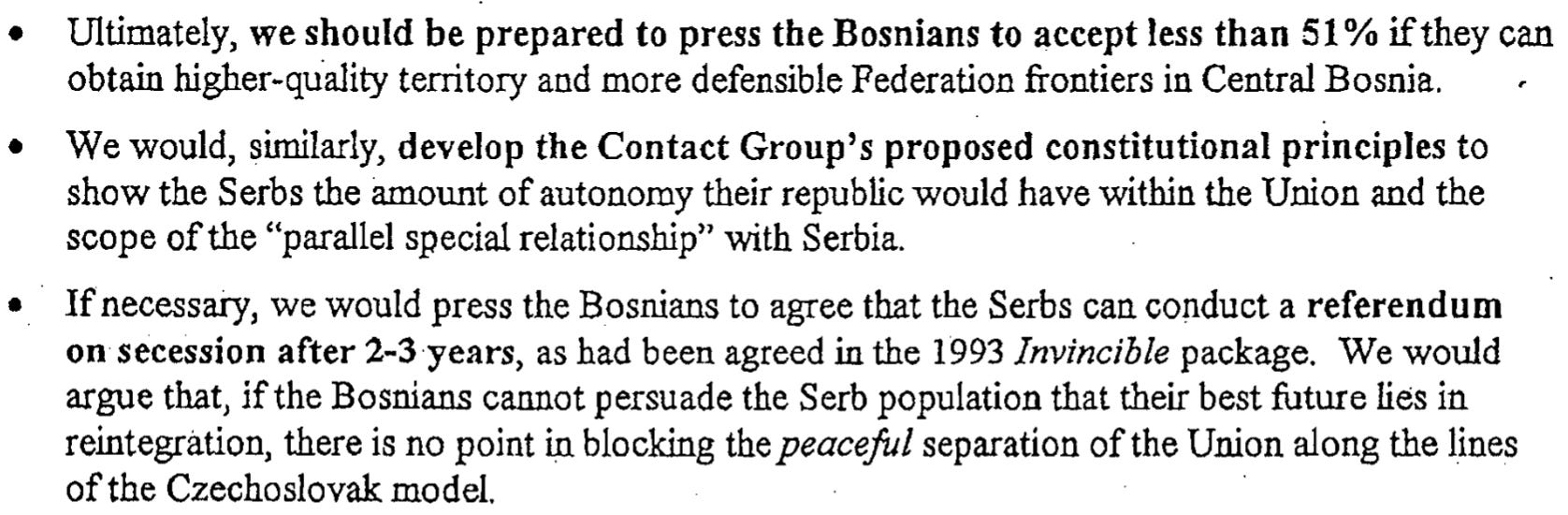
Strikingly, this perspective was also secretly shared by notoriously hawkish Secretary of State Madeleine Albright, a highly divisive figure in the Balkans due to her centrality to NATO’s bombing of Bosnia, and 1999 attack on Yugoslavia. In a little-known early August 1995 memo, Albright covertly proposed “significant alterations” to the NSC-approved peace plan that was to be pitched to the warring parties, following the bombing campaign. Specifically, she suggested Sarajevo’s post-war settlement “could be more forward-leaning on the Serbs’ right to secede peacefully from Bosnia.”
‘Political Crisis’
Elsewhere in the memo, Albright robustly dismissed as “simply wrong” any suggestion a “multinational force with a US component” occupying Sarajevo would entail “open-ended American commitment.” Under the NSC peace plan, Washington was committed to providing training to Bosniak forces until they could militarily “act themselves,” during a “transition period”. This effort was intended to ensure “minimum exposure” for the US, while serving “as a magnet for European participation.” The NSC - and Albright - foresaw the training lasting just six months to one year.
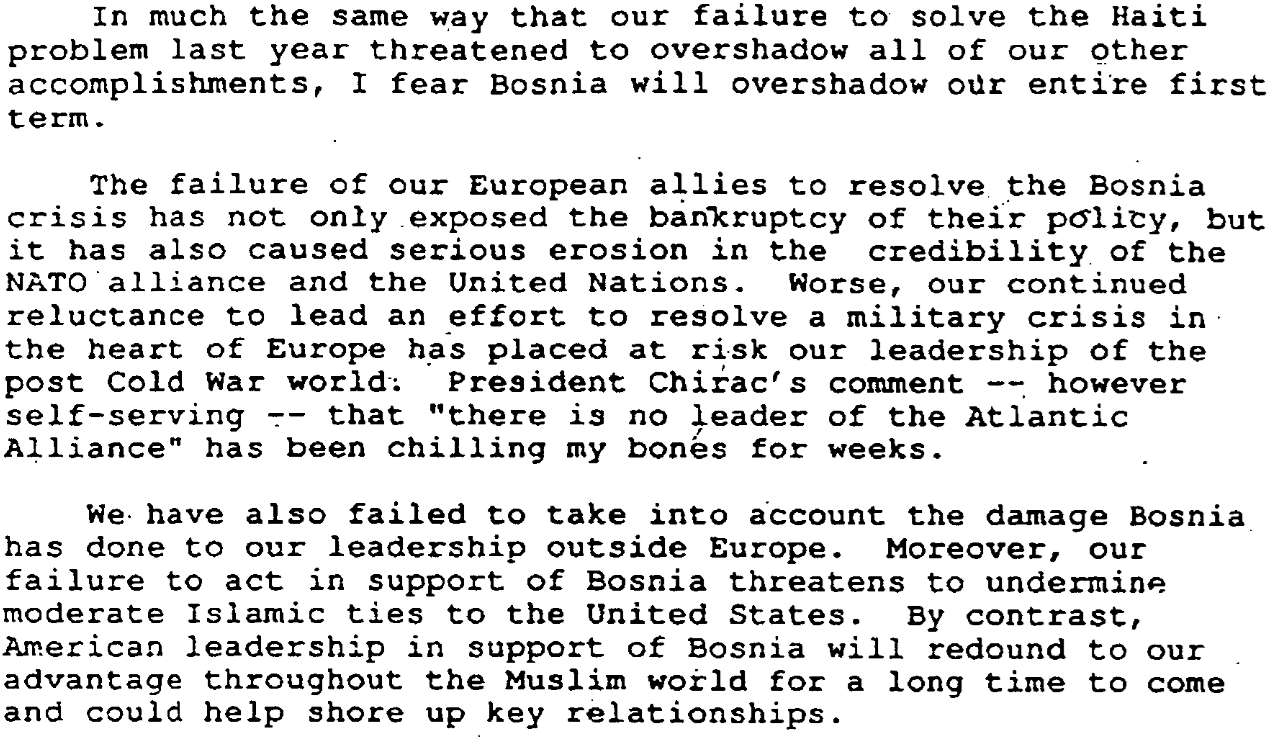
Elsewhere, she lamented “the failure of our European allies to resolve the Bosnia crisis.” Albright seethed how this had “exposed the bankruptcy of their policy” towards the former Yugoslavia, and “caused serious erosion in the credibility” of NATO and the UN. “Worse,” she lamented, Washington’s “continued reluctance to lead an effort to resolve a military crisis in the heart of Europe has placed at risk our leadership of the post Cold War world.” Today, a peaceful, unified Bosnia isn’t fundamental to US global “leadership”. An “exit strategy” could thus finally impend.
In announcing his resignation, Christian Schmidt warned of Bosnia’s “silent deconstruction”, while pledging to remain in position until a successor is selected. Yet, the Office of the High Representative’s longevity, and the Bosnian state’s in turn, is now in serious doubt. At a May 12th UN Security Council session, US Deputy Ambassador Tammy Bruce echoed the private sentiments of Clinton administration officials, stating firmly the OHR “was never intended to be permanent.” Washington expects whoever replaces Schmidt to take a largely ceremonial role, and “begin transferring responsibilities to local leaders.”
Selecting Schmidt’s successor has proven deeply problematic. A June 3rd/4th meeting of the Peace Implementation Council ended with the US and Europe unable to reach agreement on who should fill the post. Washington rejected France’s West Balkans envoy - endorsed by most European countries, including Britain and Germany - in favour of an Italian career diplomat. With the OHR still effectively leaderless, subsequently the US Embassy in Sarajevo ominously announced:
“European indecisiveness, and the PIC’s abdication of its own duty…is forcing the United States to reconsider our role in the current international presence in Bosnia and Herzegovina.”
Such words should not be diminished as a hollow threat, designed to strong-arm European governments into greenlighting a US-approved candidate for High Representative. The unipolar world anointed by the Dayton Agreement is no more, and the Empire’s complete pullout from Bosnia is a very real possibility. There is little indication the “international presence” in Sarajevo can be sustained in its present form, without the guarantee provided by US occupation for three decades. Türkiye Today has already warned of a looming, “dangerous vacuum”:
“Schmidt’s departure is not simply the exit of another international official from Sarajevo. It is becoming a test of something much larger: whether the European Union still possesses the political coherence and strategic influence to shape outcomes in the Western Balkans…Bosnia does not simply face a domestic political crisis. It faces a geopolitical one…The real question is no longer whether Bosnia can survive without the OHR. It is whether the West still knows what Bosnia is supposed to become with it.”
It’s rather forgotten how Washington’s total pullout from Afghanistan after 20 years caught not only its Kabul puppet government, but fellow NATO occupiers, completely off-guard. British officials initially mulled staying. Their delusions shattered within a day. A similar lack of preparedness on the part of US ‘allies’ is evident in Bosnia now. While the unified state created by Dayton may not collapse as precipitously, Republika Srpska is moving inexorably towards independence, as the Empire always planned. That’s a war in the making, with no guarantee European powers have the ability to “act themselves,” in Madeleine Albright’s phrase. Watch this space.
Thanks for covering this.
Unity can’t be imposed by the same external force that had broken it in the first place. It’s worrisome, but ultimately it’s up to the indigenous people themselves to forge their own future, barring any more outsider interference, of course.
Brililant, as usual!